
How to Cut a Pomegranate
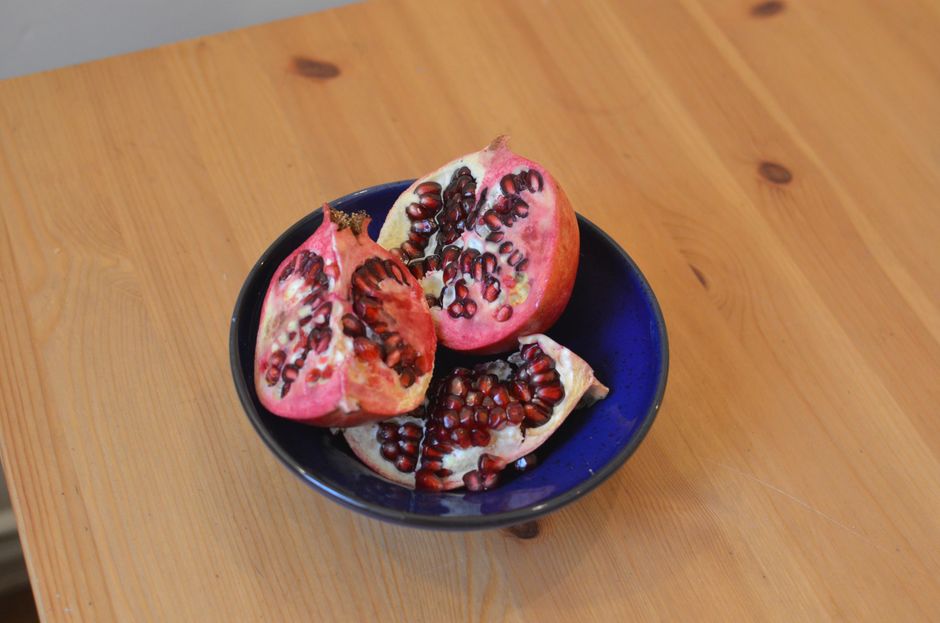
Pomegranate juice stains fabric and countertops fast, so the fastest, cleanest way to get at the arils is to score the rind and break it apart underwater, where the pith floats and the seeds sink.
Steps
- 1Slice off the crown (the small stem end) with a paring knife, cutting just deep enough to expose the white pith underneath.
- 2Look at the ridges on the outside of the skin, they mark the natural sections of pith inside. Score the rind along each ridge from top to bottom, cutting only through the skin, not into the seeds.
- 3Fill a large bowl with cold water and submerge the pomegranate.
- 4Working underwater, pull the sections apart along the scored lines with your thumbs.
- 5Rub and separate the arils from the pith with your fingers, still submerged; the seeds sink to the bottom and the white pith rises to the surface.
- 6Skim off the floating pith with a slotted spoon, then drain the arils in a colander.
Common mistakes
- Cutting through the middle of the fruit first: this slices straight through rows of seeds and sprays juice everywhere.
- Deseeding on a dry cutting board: without water, pith and juice splatter and stain instead of separating cleanly.
- Scoring too deep: cutting into the seeds themselves releases juice and makes the arils mushy.
Equipment
- Paring knife
- Large bowl
- Slotted spoon
- Colander
FAQ
Do I really need to deseed a pomegranate underwater?
It's not required, but it keeps juice off your hands and counter and makes separating the pith faster since it floats away from the seeds automatically.
How long do fresh pomegranate arils keep in the fridge?
Stored in a sealed container, deseeded arils keep for about 5-7 days in the refrigerator.
Can pomegranate arils be frozen?
Yes, spread them in a single layer on a baking sheet to freeze solid, then transfer to a freezer bag; they'll keep for up to 6 months and work well in smoothies or baking.
How do I pick a ripe pomegranate before cutting it?
Choose one that feels heavy for its size with skin that looks slightly flattened rather than perfectly round; heaviness indicates juicier arils.
Need exact temperatures or timing? Check our Time & Temperature Guide →