
How to Hold Chopsticks
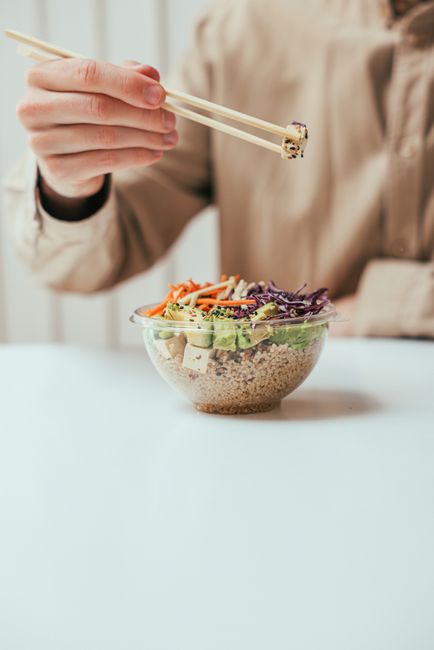
Most chopstick struggles come down to one thing: letting both sticks move instead of keeping one fixed. Once the bottom stick stays still and only the top one pivots, picking up rice, noodles, or slippery dumplings gets much easier.
Steps
- 1Rest the thicker end of one chopstick in the crook between your thumb and index finger, letting the other end rest on the top knuckle of your ring finger.
- 2Hold this bottom chopstick still. It should not move for the rest of the grip; it acts as a stable base.
- 3Hold the second chopstick like a pencil, pinched between the tip of your index finger and thumb, resting on your middle finger.
- 4Position the top chopstick so its tip lines up evenly with the tip of the bottom one when your hand is relaxed.
- 5Move only your index finger and thumb up and down to open and close the top chopstick against the fixed bottom one.
- 6Practice picking up something with give, like a piece of bread or a cooked green bean, before trying rice or noodles.
Common mistakes
- Letting both chopsticks move: if the bottom stick shifts around, the tips never line up and food slips out.
- Crossing the chopsticks like an X: this usually means the bottom stick isn't anchored on the ring finger properly.
- Gripping too far up the sticks: holding them near the middle instead of the top third reduces control and leverage.
- Using a fist grip: closing the whole hand around both sticks removes the fine motor control needed to open and close them.
Equipment
- Chopsticks (wooden or plastic training chopsticks are easier to start with than metal)
FAQ
Should I use training chopsticks to learn?
Training chopsticks with a hinge at the top are useful for building the pinching motion, but switching to regular chopsticks quickly afterward prevents relying on the hinge as a crutch.
Why do my chopsticks keep crossing into an X shape?
This happens when the bottom chopstick isn't anchored against the base of the thumb and the ring finger knuckle, so it slides and angles inward as the top stick moves.
Is it okay to hold chopsticks close to the tips for more control?
Holding too close to the tips actually reduces leverage and makes the grip feel cramped; holding about a third of the way down from the top gives more range of motion.
Which foods are hardest to pick up while learning?
Loose rice grains and round items like peanuts are the most difficult since they require precise, even pressure from both fingertips at once.
Need exact temperatures or timing? Check our Time & Temperature Guide →