
Butter Cookies
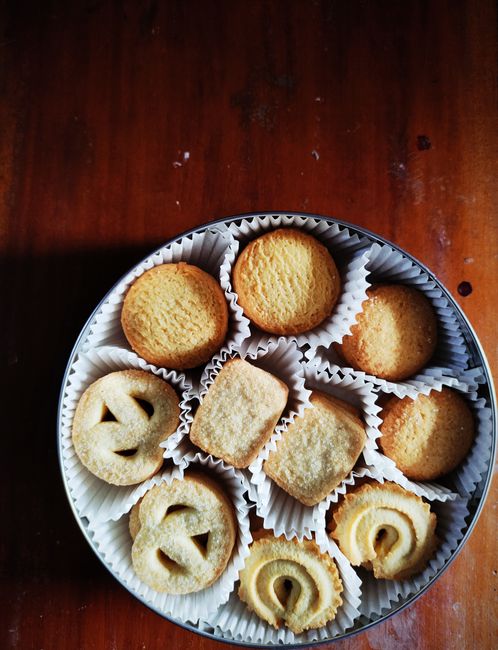
Butter cookies are dense, crisp cookies made mostly from butter, sugar, and flour, with little or no leavening, which is what gives them their compact, short texture instead of a light, cakey crumb. The category covers everything from Danish butter cookies sold in blue tins to French sablés and simple American butter cookies piped or rolled and baked plain or dusted with sugar. Recipes call for them both as a stand-alone cookie and, crushed, as a crust or crumb topping in the same way graham crackers or vanilla wafers are used.
Varieties
Danish butter cookies are piped or extruded into pretzel, swirl, and ring shapes and are noticeably drier and denser than French sablés, which use a higher proportion of egg yolk for a more tender, sandy crumb. Scottish shortbread skips eggs almost entirely and relies on a higher butter-to-flour ratio, giving it a crumblier bite than either.
Buying tips
Danish-style tins (Kjeldsens, Royal Dansk) hold up well for gifting and long storage; check that the cookies feel firm and don't rattle loosely, which can signal staleness. For crust-making, plain, unfrosted varieties crush more evenly than iced or chocolate-dipped ones.
Substitutes
Shortbread cookies — 1:1 by weight
Nearly identical fat and sugar ratio, so crusts and crumbles behave the same; shortbread is slightly less sweet.
Vanilla wafers — 1:1 by weight
Lighter and slightly sweeter with less butter flavor; works fine for crusts but crumbs are less compact, so add an extra tablespoon of melted butter per cup of crumbs.
Graham crackers — 1:1 by weight
Adds a honeyed, wheaty flavor instead of pure butter; a common and reliable swap for pie and cheesecake crusts.
Digestive biscuits — 1:1 by weight
Slightly less sweet and a bit more crumbly; standard substitute outside the US where butter cookies aren't as common on shelves.
Sugar cookies — 1:1 by weight
Sweeter and less rich; fine for eating out of hand but crusts made from them can taste flat without a little extra melted butter.
Storage
Keep in an airtight tin or container at room temperature away from humidity; they stay crisp for 3 to 4 weeks unopened and about 1 to 2 weeks once the tin is opened and resealed each time. Unbaked dough logs freeze well for up to 3 months, wrapped tightly in plastic and foil.
How to use
Eat plain with coffee or tea, crush into crumbs for pie and cheesecake crusts, layer crushed into trifles and icebox cakes, or fold coarsely broken pieces into ice cream and no-bake bars. Crushed butter cookies make a firmer, more buttery crust than graham crackers and need slightly less added fat.
What it pairs with
Pairs well with black coffee, Earl Grey or other black teas, and fruit preserves; crushed into crusts, they go especially well with lemon curd, cheesecake, and vanilla or coffee ice cream fillings.
Nutrition
Butter cookies are calorie-dense for their size, since butter can make up close to a quarter of the dough by weight; a typical small Danish butter cookie runs 40 to 60 calories, most of it from fat and sugar.
FAQ
Can I use margarine instead of butter to make butter cookies?
You can, but the flavor and texture change noticeably; margarine has more water and less milk fat, so the cookies spread more and taste flatter. Use a stick margarine labeled for baking, not a tub spread, if substituting.
Why did my butter cookies spread too much?
Dough that's too warm or butter that was too soft when creamed causes spreading; chill shaped dough for at least 20 minutes before baking and use butter at cool room temperature, around 65°F.
How many butter cookies equal one cup of crumbs for a crust?
About 20 to 24 standard Danish-style butter cookies (roughly 5 ounces) crushed finely will make one cup of crumbs, similar to 9 full graham cracker sheets.
Do butter cookies and sugar cookies use the same recipe?
No. Butter cookies use a much higher ratio of butter to flour and usually little or no leavening, giving a dense, short texture, while sugar cookies typically include baking powder or soda for a softer, slightly puffed crumb.
Have butter cookies on hand? Find recipes with our Recipe Generator →