
Comté Cheese
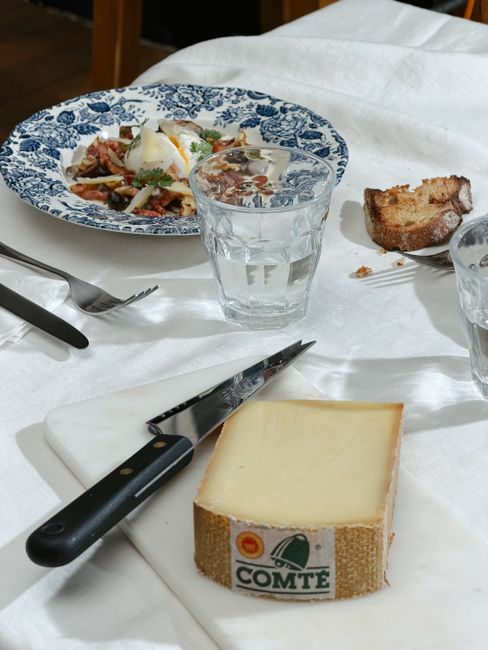
Comté is a raw cow's milk cheese from the Franche-Comté region of eastern France, made under strict AOP rules from the milk of Montbéliarde and French Simmental cows grazing a defined mountain area. Each wheel is aged in caves for a minimum of four months and often 12 to 36 months, developing a firm, dense paste with flavors that range from milky and nutty when young to notes of brown butter, hazelnut, caramel, and sometimes dried fruit or beef broth as it ages. It's produced in large wheels, roughly 40 kilograms each, and graded by inspectors who assign a color-coded band (green, brown, or black) indicating quality tier.
Varieties
Age is the real distinguishing factor rather than separate named varieties. Comté aged 4 to 8 months (jeune) is mild and milky; 12 to 18 months develops nuttier, more rounded flavor; anything beyond 24 months (vieux or extra-vieux) turns drier, crumblier, and more intense, often with small white crunchy crystals of tyrosine.
Buying tips
Look for the color-coded oval label stamped on the rind: green indicates the top quality grade, brown a good standard grade, and black a lower grade sold under a different name. Ask for a taste before buying if possible, since flavor varies significantly by age, and choose wheels aged at least 12 months for cooking or 18-plus months for a cheese board.
Substitutes
Gruyère — 1:1
The closest match in texture and nutty flavor; Swiss Gruyère melts just as well in gratins and fondue.
Beaufort — 1:1
A close cousin made in the neighboring French Alps using similar methods; slightly more assertive and grassy.
Emmental — 1:1
Milder and softer, with less depth; works fine melted but lacks the caramelized complexity of aged Comté.
Aged Gouda — 3/4:1
Sweeter and more caramel-forward with a firmer, drier texture; use slightly less since the flavor is more concentrated.
Parmigiano-Reggiano — 1/2:1
Only a good stand-in for grating over pasta or gratins, not for melting into a smooth fondue; much saltier and sharper, so use less.
Storage
Wrap tightly in wax or cheese paper rather than plastic wrap, which traps moisture and smothers the rind. Store in the warmest part of the refrigerator, typically a produce or cheese drawer, and it will keep for 3 to 4 weeks once cut. Let it come to room temperature for 30 to 60 minutes before serving to bring out its full flavor.
How to use
Melts smoothly with almost no separation, making it a standard choice for fondue, croque monsieur, French onion soup, and gratins like gratin dauphinois. Younger Comté works well shaved into salads or on a sandwich, while wheels aged 18 months or more are best served on a cheese board where their crystalline texture and caramel notes stand on their own.
What it pairs with
Pairs well with Jura wines like vin jaune, dry white Burgundy, or a crisp hard cider. On a cheese board, serve alongside walnuts, dried apricots, charcuterie like jambon de Bayonne, and a mild honey for drizzling.
Nutrition
Like most hard cheeses, Comté is calorie-dense and high in saturated fat and sodium, but it's also a strong source of calcium, protein, and vitamin B12. A 1-ounce serving delivers around 110 to 120 calories and roughly 7 to 8 grams of protein.
FAQ
Is Comté the same as Gruyère?
No, though they're closely related. Both are Alpine-style cheeses made from raw cow's milk, but Comté is produced only in France under AOP rules, while Gruyère is a protected Swiss designation with its own distinct production standards and flavor profile.
Why does Comté have a range of flavors even from the same producer?
Flavor depends heavily on aging time and the season the milk was produced. Comté made from summer milk, when cows graze on fresh pasture, tends to taste grassier and more floral than winter batches made from hay-fed milk.
Can Comté be frozen?
It can, but freezing changes the texture, making it crumblier and less smooth when it thaws. It's best reserved for cheese that will be melted into cooked dishes rather than served on a board.
What do the small crunchy bits in aged Comté mean?
Those are tyrosine crystals, an amino acid that forms naturally as protein breaks down during long aging. They're a sign of a well-aged, high-quality wheel, not a defect.
Have comté cheese on hand? Find recipes with our Recipe Generator →