
Corn Ribs
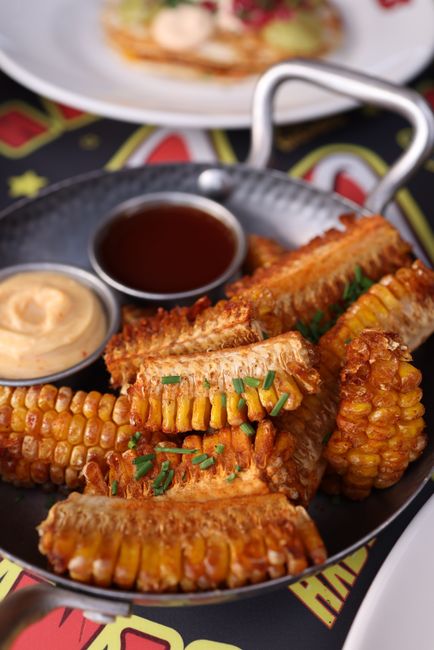
Corn ribs are fresh ears of corn cut lengthwise into four to six curved strips, each still attached to a section of cob and rows of kernels. The name comes from their shape once cooked: as the cob dries out under heat, each strip curls backward, resembling a small rack of ribs. They're not a separate ingredient so much as a cutting technique applied to regular sweet corn, popularized as a shareable appetizer in place of corn on the cob.
Varieties
Any sweet corn variety, yellow, white, or bicolor, works for this cut; it's a preparation technique rather than a specific corn type. Despite the name, corn ribs have no relation to pork or beef ribs beyond visual resemblance once cooked.
Buying tips
Choose large, thick ears with tightly wrapped bright green husks and moist (not dried or blackened) silks. Bigger, sturdier ears are easier and safer to quarter with a knife than thin or short ones.
Substitutes
Fresh corn on the cob cut into rounds (corn coins) — 1:1 by weight of corn used
Same corn, cut crosswise into 1-inch wheels instead of lengthwise strips. Much easier and safer to cut, cooks the same way, but loses the rib shape and curling effect.
Frozen corn on the cob, thawed and quartered lengthwise — 1:1
Works in a pinch but the cob is softer and wetter after freezing, so pieces are more prone to breaking apart when cut and won't curl as dramatically when roasted.
Baby corn, halved lengthwise — Use 4-5 baby corn halves per 1 full corn rib
Much smaller and more tender, with almost no cob to gnaw on. Good for a finger-food platter but a very different eating experience.
Zucchini or eggplant cut into rib-shaped strips — Not directly substitutable
Only mimics the shape and dipping-sauce format, not the corn flavor. Useful for a vegetable platter alongside actual corn ribs, not as a stand-in for corn flavor.
Storage
Raw, cut corn ribs dry out quickly once exposed at the cob, so store them in an airtight container in the refrigerator and use within 2 days. Cooked corn ribs keep refrigerated for 3-4 days and reheat best in a 400°F oven or air fryer for 5-7 minutes to re-crisp the edges; microwaving makes them soft and rubbery.
How to use
Served mainly as an appetizer or shareable snack, roasted, air-fried, or grilled, then tossed in butter and chili powder, cotija cheese, or a chipotle-lime glaze similar to Mexican street corn (elote). The curled shape makes them easy to pick up and dip by hand.
What it pairs with
Pairs naturally with lime, chili powder or tajin, cotija or parmesan cheese, cilantro, and chipotle mayo or crema, the same flavor profile as elote and esquites.
Nutrition
Nutritionally identical to the corn they're cut from: a good source of fiber and vitamin C, moderate in natural sugars. Because the cut surface area is larger, corn ribs pick up more butter, oil, or cheese per bite than a whole cob, so calorie counts run higher depending on how they're finished.
FAQ
How do you cut corn into ribs safely?
Microwave the husked ear for 3-4 minutes to soften the cob, let it cool slightly, then stand it on its end and use a large, sharp knife to cut straight down through the center, then quarter each half again, cutting away from your hand each time.
Can you make corn ribs from frozen corn on the cob?
Yes, but thaw it fully and pat it dry first. Frozen cob softens more than fresh, so cuts are less clean and the curling effect when roasted is noticeably weaker.
Why do corn ribs curl when they cook?
The cob loses moisture faster than the kernels do, so it contracts and pulls the strip backward. Higher, drier heat like roasting or grilling produces more curl than steaming or boiling.
What's the best way to cook corn ribs?
Roast at 425°F for 20-25 minutes, flipping halfway, or air fry at 400°F for 12-15 minutes. Both give charred edges and a good curl; grilling over medium-high heat for about 10 minutes works too but requires closer watching to avoid burning the kernels.
Have corn ribs on hand? Find recipes with our Recipe Generator →