
Croissant
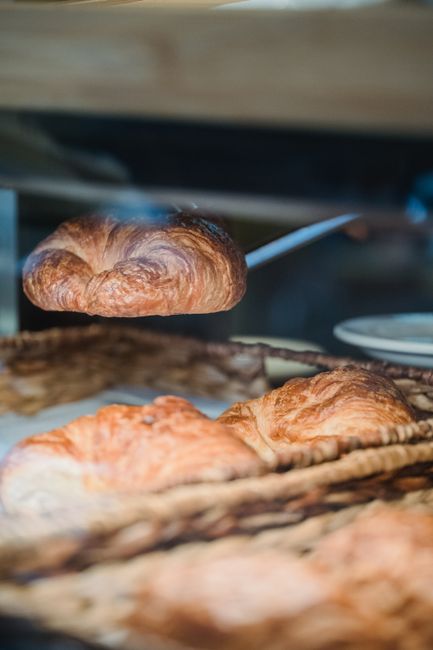
A croissant is a laminated, yeasted pastry made by folding thin layers of butter into dough, then rolling and folding repeatedly before shaping into a crescent and baking. The lamination process creates dozens of alternating butter-and-dough layers that puff and separate in the oven, giving a shatter-crisp exterior and a soft, honeycombed interior. Plain butter croissants are the base for variations like pain au chocolat, almond croissants, and ham-and-cheese versions.
Varieties
Plain butter croissants (croissant au beurre) use all-butter dough and taste richer than ordinary croissants made with margarine or a butter blend, which are common in mass-produced versions. Pain au chocolat uses the same laminated dough wrapped around chocolate batons, while almond croissants are usually made from day-old croissants re-soaked in syrup and filled with almond cream, giving them a denser, moister texture than a fresh plain croissant.
Buying tips
Choose croissants with a deep golden color and visible, distinct layers on the cut ends rather than a smooth, uniform crust, which signals less lamination. A fresh croissant should feel light for its size and shatter slightly when torn; a heavy, dense one has likely absorbed too much moisture or was underproofed.
Substitutes
Brioche bread — 1:1 by weight
Similarly rich and buttery but denser and eggier, without the flaky layers. Works well in bread pudding and French toast where texture matters less than richness.
Challah bread — 1:1 by weight
Slightly less buttery than croissant but a close match for sweetness in French toast or a bread pudding.
Puff pastry, baked and split — Use roughly equal weight of baked pastry
Delivers flaky layers without the yeasted chew of a croissant. Best for savory fillings like ham and cheese, not for soaking-based dishes like bread pudding since it turns soggy quickly.
Crescent roll dough, baked in a coil or fan shape — 1:1 by piece
A much less buttery, less flaky stand-in that works for breakfast sandwiches in a pinch, but lacks the crisp shatter of a true croissant.
Storage
Store fresh croissants at room temperature in a paper bag for up to 2 days; a paper bag lets excess moisture escape so the layers stay crisp, while a sealed plastic bag traps steam and makes them go soft. For longer storage, freeze baked croissants wrapped tightly in foil for up to 2 months and re-crisp in a 300°F oven for 5 to 7 minutes after thawing.
How to use
Split and use as a base for breakfast sandwiches with egg and cheese, cube and soak for croissant bread pudding, slice thin and toast for croutons on a salad, or tear day-old croissants for French toast since slightly stale croissants absorb custard without falling apart.
What it pairs with
Pairs well with strong coffee or espresso, fruit preserves, dark chocolate, sliced almonds, and savory fillings like ham, gruyere, or scrambled eggs.
Nutrition
Croissants are high in saturated fat and calories relative to their size because of the layered butter, and are made from refined flour with little fiber. A standard bakery croissant runs roughly 230 to 280 calories depending on size.
FAQ
Why do my homemade croissants come out dense instead of flaky?
Dense croissants usually mean the butter melted into the dough during lamination instead of staying in distinct layers, often from a kitchen that's too warm or not enough resting time between folds. Keep the dough and butter block cold throughout, chilling 20 to 30 minutes between each fold.
Are croissants French in origin?
The shape descends from the Austrian kipferl, but the modern laminated, buttery croissant was developed and popularized by Parisian bakeries in the 19th century, which is why it's associated with France today.
Can croissant dough be frozen before baking?
Yes. Shape the croissants, freeze them unproofed on a tray until solid, then transfer to a bag. Thaw overnight in the refrigerator and let them proof at room temperature for 2 to 3 hours before baking.
How do I refresh a stale croissant?
Warm it in a 300°F oven for 5 to 7 minutes rather than microwaving, which turns the layers rubbery instead of crisp.
Have croissant on hand? Find recipes with our Recipe Generator →