
Daikon
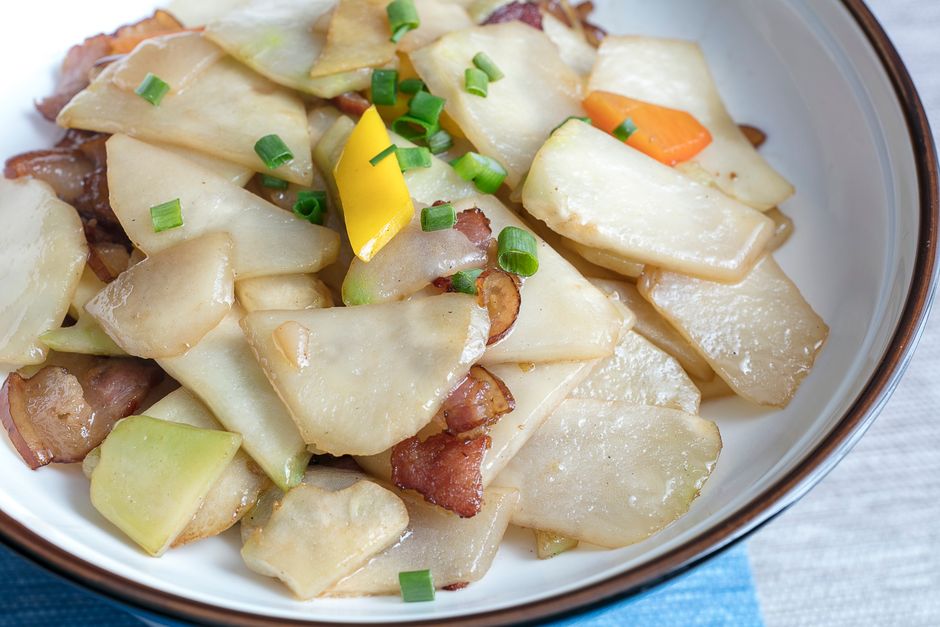
Daikon (Raphanus sativus) is a long, white winter radish common in Japanese, Korean, and Chinese cooking. It has a crisp, watery texture and a flavor that's mild and slightly sweet raw, turning peppery only near the skin, with a much softer, almost translucent texture once simmered or braised.
Varieties
Korean mu is shorter, wider, and denser than the long, slender Japanese daikon, and holds up better in stews without turning mushy. Chinese daikon (luobo) varieties overlap closely with Japanese types and are used interchangeably in most home cooking.
Buying tips
Choose daikon that feels heavy and firm for its size with smooth, unblemished white skin. Avoid roots that are soft, spongy, or have visible cracks, which signal a woody, pithy interior. Smaller to medium roots (around 12-14 inches) tend to be more tender than very large ones.
Substitutes
Watermelon radish — 1:1
Similar crisp texture and mild flavor raw; the pink-and-white interior changes the look of the dish.
Jicama — 1:1
Sweeter and stays crunchy even when cooked, so it won't soften into braises the way daikon does.
Green papaya, shredded — 1:1
Works well for slaws and quick pickles; milder flavor with a similar crisp bite.
Turnip — 1:1
Firmer and slightly more bitter and peppery; best in cooked dishes like soups or braises rather than raw.
Regular red radish — 1:1
Much sharper and spicier; use for quick pickles or raw slaws, not for long-simmered dishes.
Storage
Trim off any leafy greens (they pull moisture from the root) and wrap the unpeeled daikon in a damp paper towel or plastic bag. Refrigerate in the crisper drawer for up to two weeks. Cut pieces should be stored submerged in water in a sealed container and used within about four days, changing the water every day or two.
How to use
Grate raw and serve alongside tempura or grilled fish as a palate cleanser. Julienne for slaws and quick pickles (it's the base of Korean kkakdugi and the pink pickled daikon served with Vietnamese banh mi). Simmer in slices or chunks in broths, oden, or Japanese nimono, where it absorbs the surrounding flavor and turns tender and translucent. Shred and stir into savory pancakes like Chinese turnip cake, which is actually made with daikon despite the name.
What it pairs with
Pairs well with soy sauce, miso, ginger, and dashi in Japanese cooking, with gochugaru and fish sauce in Korean pickles, and with fatty foods like pork belly or fried dishes, which its mild bitterness and crunch help cut through.
Nutrition
Daikon is very low in calories, around 18 per 100 grams, and mostly water. It provides some vitamin C and modest fiber and potassium, more concentrated near the skin and the top end of the root.
FAQ
Do you need to peel daikon?
Peeling is optional. The skin is edible but slightly tougher and more fibrous than the flesh, so most cooks peel it for salads and pickles but leave it on for long-simmered dishes where it softens fully.
Why is my cooked daikon bitter?
Bitterness usually comes from the greener top third of the root, nearest the leaves. Trimming that section off and using only the lower two-thirds for cooking reduces bitterness noticeably.
Can daikon be eaten raw?
Yes. Raw daikon is crisp and mild, closer to jicama than to spicy red radish, and is commonly grated or thinly sliced for salads, garnishes, and pickles.
How do you keep daikon from turning watery in a salad?
Salt the shredded or sliced daikon lightly and let it sit for 10-15 minutes, then squeeze out the released liquid before dressing it, similar to how you'd treat cucumber.
Have daikon on hand? Find recipes with our Recipe Generator →