
Easter Eggs
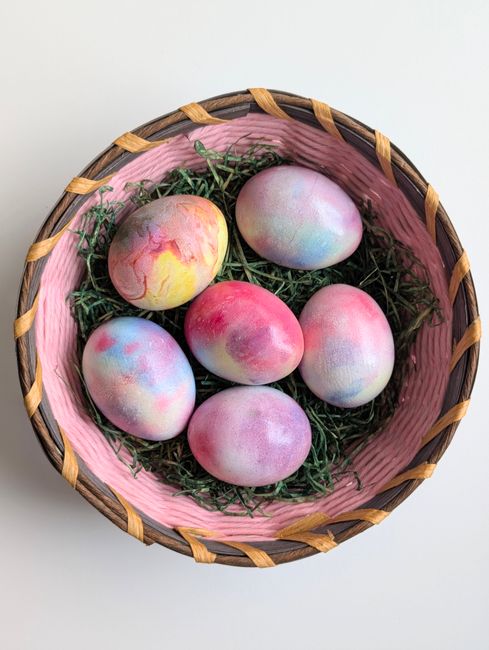
Easter eggs are hard-boiled chicken eggs dyed or decorated for the holiday, meant to be handled, hidden, and displayed before eventually being eaten or discarded. The eggs themselves are ordinary hard-boiled eggs; what changes is how they're cooked (for a peelable, unblemished shell), how they're cooled, and how long they can safely sit at room temperature once dyed and handled.
Varieties
Natural dye methods (beet juice, turmeric, red cabbage water with vinegar) produce softer, more matte colors than commercial dye tablets, which use food-grade acid dyes for brighter, glossier results.
Buying tips
Buy eggs at least a few days to a week before boiling; very fresh eggs are harder to peel cleanly because the white clings to the membrane. White-shelled eggs show dye colors more vividly than brown-shelled eggs, which mute pastel dyes into earthier tones.
Substitutes
Blown-out eggs (raw egg emptied through a pinhole) — 1:1
Same shell, no yolk or white inside, so they never spoil and can be kept indefinitely as decorations or ornaments.
Plastic eggs — 1:1
Standard for egg hunts with candy or small toys inside; skip food safety concerns entirely and can be reused every year.
Wooden eggs — 1:1
Take paint and decoration well, last for years, and work for households avoiding real eggs due to allergy or waste concerns.
Duck or goose eggs — 1:1
Larger and thicker-shelled than chicken eggs, so they take a few extra minutes to hard-boil but hold dye just as well.
Storage
Dyed hard-boiled eggs that have been at room temperature for an egg hunt or display should not sit out longer than 2 hours total. If they've stayed cool and been refrigerated promptly after boiling, they keep in the shell in the fridge for up to a week. Once peeled, eat within a day or two. Discard any egg that has been out of refrigeration for more than 2 hours, cracked, or handled with unwashed hands over an extended hunt.
How to use
Peeled hard-boiled Easter eggs work in egg salad, deviled eggs, chopped into potato salad, sliced onto salads or ramen, or eaten plain with salt. If a large batch was dyed for decoration and sat out during a hunt, treat those as decorative only and boil a separate, clean batch for eating.
What it pairs with
Leftover peeled Easter eggs pair well with mustard, mayonnaise, everything bagel seasoning, or vinegar-based relish for deviled eggs, and with crisp greens or roasted asparagus for a spring lunch plate.
Nutrition
A large hard-boiled egg has about 70 calories, 6 grams of protein, and 5 grams of fat, along with choline and vitamin D. Dyeing has no effect on nutrition since dye stays on the shell.
FAQ
How long can dyed Easter eggs sit out before they're unsafe to eat?
No more than 2 hours total at room temperature, including the time spent during an egg hunt. Beyond that, bacteria can grow even though the eggs look fine.
Why do some hard-boiled eggs have a greenish-gray ring around the yolk?
That ring forms when eggs are boiled too long or cooled too slowly, from a reaction between sulfur in the white and iron in the yolk. It's harmless but means the egg was overcooked.
Can you eat eggs after they've been hidden outside for an egg hunt?
It's safer not to, especially if they sat in direct sun, damp grass, or above 2 hours. Boil a separate clean batch specifically for eating and use the hunt eggs for display or compost.
How do you make hard-boiled eggs easier to peel for decorating?
Use eggs that are at least 3 to 5 days old, and shock them in an ice bath immediately after boiling for at least 10 minutes before peeling or dyeing.
Have easter eggs on hand? Find recipes with our Recipe Generator →