
Fig Newtons
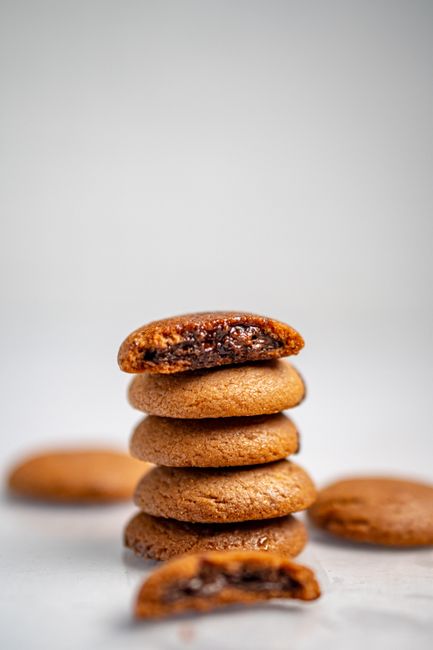
Fig Newtons are a soft, rectangular cookie (Nabisco calls them a cake, not a cookie) made of a thin, tender pastry wrapped around a dense fig paste filling. Invented in Massachusetts in the 1890s and named after the nearby town of Newton, they're one of the few mass-market cookies built around a fruit filling rather than chocolate or sugar dough.
Varieties
Nabisco briefly rebranded the product as simply "Newtons" in the 1990s and expanded the line into raspberry, strawberry, blueberry, and apple versions before restoring the Fig Newton name for the original. Whole wheat and reduced-sugar versions are also sold; they swap the crust for a whole-grain dough but keep the same fig filling.
Buying tips
Squeeze the box gently through the wrapping; cookies should feel soft, not hard or brittle, which signals they've dried out on the shelf. Check the date stamp on the bottom flap, since fig bars lose their soft texture faster than drier cookies once they pass peak freshness.
Substitutes
Nature's Bakery or another brand fig bar — 1:1
Softer and less sweet than Nabisco's version, but the closest match in shape, texture, and fig content for snacking or crumbling into a crust.
Store-brand fig cookies — 1:1
Usually a firmer, drier crust than name-brand Fig Newtons; works fine crushed into crumbs but eats slightly less soft on its own.
Graham cracker crumbs mixed with fig jam — 1 cup crumbs plus 2 tablespoons jam per cup of crushed Fig Newtons
Good stand-in when a recipe calls for crushed Fig Newtons in a pie or bar crust; press and bake as you would a graham crust.
Chopped dried Mission figs plus shortbread crumbs — Equal parts by weight
Delivers the same chewy-fig-in-crumbly-pastry contrast for no-bake bars, though it's noticeably less sweet than the packaged cookie.
Homemade fig bar dough (butter cookie dough wrapped around fig paste) — Not a fixed ratio
Best when a recipe actually calls for baking fig bars from scratch rather than substituting a packaged product mid-recipe.
Storage
Keep the box sealed or transfer opened cookies to an airtight container at room temperature; they stay soft for about 2 to 3 weeks. They dry out and turn leathery if left uncovered, so don't store them in an open bag. For longer storage, freeze in a zip-top bag for up to 3 months and thaw at room temperature for about 20 minutes.
How to use
Eaten straight from the package as a snack, but also crushed into crumbs for pie and cheesecake crusts, layered with cream cheese and whipped topping for a no-bake icebox cake, blended into milkshakes, or chopped and folded into oatmeal cookie dough for extra chew.
What it pairs with
Pairs well with sharp cheddar or blue cheese for a sweet-savory snack plate, with strong black coffee or Earl Grey tea, and with vanilla ice cream when warmed slightly and crumbled on top.
Nutrition
Two cookies (about 29 grams) run roughly 100 to 110 calories, with 2 grams of fiber from the fig filling, about 9 grams of sugar, and very little fat. They're a slightly better-fiber option than most packaged cookies, but still a sugar-forward snack rather than a health food.
FAQ
Are Fig Newtons vegan?
Nabisco's original Fig Newtons are made without dairy or eggs and are typically considered vegan, though the box should be checked each purchase since formulations occasionally change.
Why does the package call them a cake instead of a cookie?
The filling's high moisture content technically classifies them as a soft cake under some baking definitions, which is why older Nabisco packaging used the phrase "fruit chewy cookies" rather than a hard cookie label.
Can Fig Newtons be frozen?
Yes. Freeze them in a sealed bag for up to 3 months; they thaw quickly at room temperature and the texture holds up better than most soft cookies.
Is there a gluten-free Fig Newton?
Nabisco does not currently sell a gluten-free version, but several smaller brands, including Nature's Bakery's gluten-free fig bars, use rice flour or oat flour crusts as a close substitute.
Have fig newtons on hand? Find recipes with our Recipe Generator →