
Futomaki
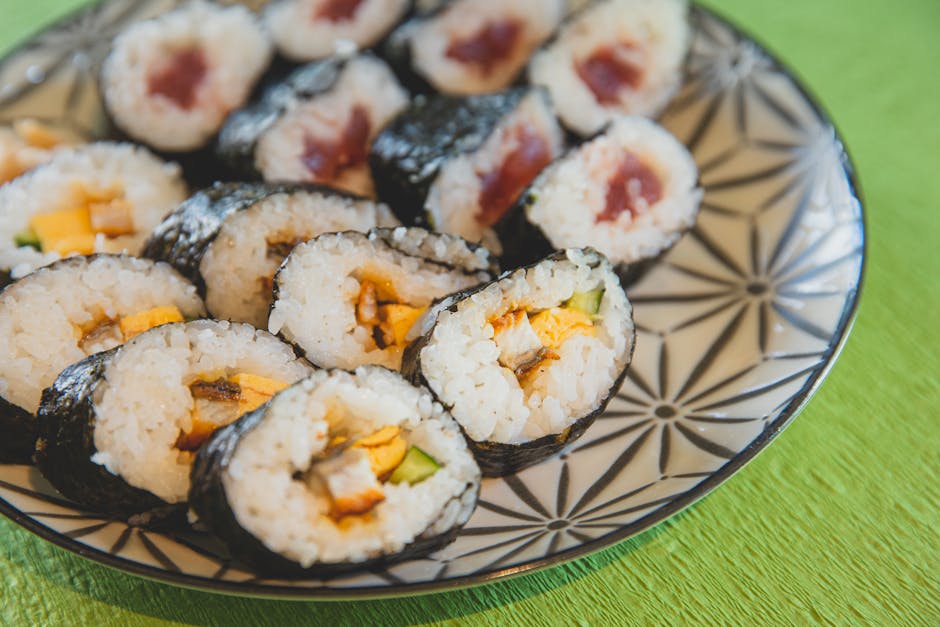
Futomaki is a thick Japanese sushi roll, typically 1.5 to 2 inches across, wrapped in a full sheet of nori with the seaweed on the outside and vinegared sushi rice packed around several fillings arranged in strips. Unlike a single-filling roll, futomaki usually holds four to six ingredients at once, often cooked rather than raw: simmered kanpyo (dried gourd), tamagoyaki (sweet rolled egg), shiitake, spinach, cucumber, and crab or fish are common. Each roll is sliced into six to eight rounds and served as a group, showing off the pattern of fillings in the center.
Varieties
Futomaki is one of several standard roll formats: hosomaki is thin, holds a single filling, and is wrapped with the nori on the outside; uramaki flips the rice to the outside and is usually single or double filling; temaki is hand-rolled into a cone and eaten immediately before the nori softens. Futomaki is distinguished mainly by its size and by holding multiple fillings arranged in a deliberate pattern.
Buying tips
When buying pre-made futomaki, choose rolls made the same day, since the nori softens and turns rubbery after about 24 hours in the refrigerator case. The rice should look glossy and separate, not dry or clumped, and any egg or crab filling should look freshly colored, not dull or gray at the edges.
Substitutes
Uramaki (inside-out roll, same fillings) — 1:1
Rice goes on the outside instead of the nori, giving a milder seaweed flavor and a softer bite; use the exact same fillings and cut the same way.
Temaki (hand-rolled cone) — 2 hand rolls : 1 futomaki roll
Hand rolls hold noticeably less rice and filling per piece, so plan on roughly two hand rolls to use up the fillings from one futomaki roll.
Soy paper roll (same fillings, no seaweed) — 1:1
Swap the nori sheet for soy paper if diners dislike the taste of seaweed; soy paper is slightly sweeter, sturdier, and adds a bit more fat and protein.
Chirashi (scattered sushi bowl) — not a fixed ratio
Skips rolling entirely: the same sushi rice, vegetables, and fish are layered in a bowl instead, which works when nori or rolling equipment isn't available but changes the presentation completely.
Storage
Futomaki is best eaten within a few hours of rolling. Refrigeration hardens the vinegared rice and makes the nori chewy, so store rolls at cool room temperature under a damp cloth or loosely covered plastic wrap if serving within 2 to 3 hours, and refrigerate only if necessary, letting rolls sit at room temperature for 20 to 30 minutes before serving to soften the rice again.
How to use
Served as a shareable appetizer or party platter, packed into bento boxes since it holds together well when sliced ahead, and often the roll of choice for vegetarian sushi platters because so many traditional fillings (egg, cucumber, kanpyo, shiitake) contain no raw fish.
What it pairs with
Serve with soy sauce for dipping, a small mound of wasabi, and pickled ginger to reset the palate between pieces. A light miso soup or a cucumber sunomono salad rounds out a futomaki platter without competing with its flavors.
Nutrition
A typical futomaki roll runs 300 to 350 calories depending on fillings, most of it from the vinegared rice's carbohydrates. Cooked fillings like tamagoyaki and kanpyo keep fat low; rolls with mayonnaise-based fillings or tempura bits raise the fat and calorie count considerably.
FAQ
Does futomaki always contain raw fish?
No. Traditional futomaki is often entirely cooked or vegetarian, built around simmered kanpyo, tamagoyaki, shiitake, spinach, and cucumber; raw fish is optional and less common than in thinner roll styles.
Why is futomaki cut into rounds instead of served whole?
Slicing exposes the cross-section of fillings, which is part of the presentation, and makes the thick roll manageable to eat in one or two bites per piece.
What does 'futomaki' actually mean?
It translates roughly to 'thick roll' in Japanese, distinguishing it from hosomaki ('thin roll') by size and filling count rather than by any specific ingredient.
Can futomaki be made ahead for a party?
Yes, roll and slice it up to 2 to 3 hours ahead and keep it loosely covered at room temperature; refrigerating longer than that will noticeably stiffen the rice and nori.
Have futomaki on hand? Find recipes with our Recipe Generator →