
Lactation Cookies
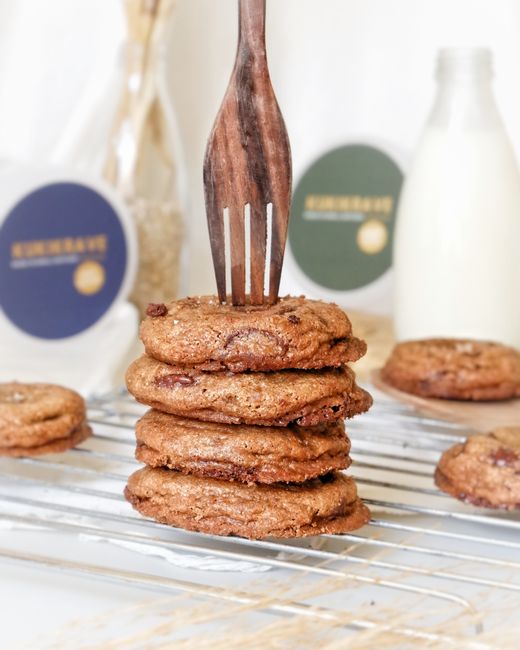
Lactation cookies are oatmeal-based cookies built around a handful of ingredients, most commonly brewer's yeast, ground flaxseed, and oats, that are traditionally believed to act as galactagogues (substances that support breast milk supply). Structurally they're just a dense, chewy oatmeal cookie; the difference is the addition of brewer's yeast and flax meal folded into a standard base, sometimes with chocolate chips or dried fruit added for flavor since brewer's yeast alone tastes bitter and slightly malty.
Varieties
Some recipes swap the cookie format for lactation 'bites' or bars made with the same base ingredients but no baking, using oats, nut butter, and honey pressed into a pan instead of scooped and baked; these are softer and more granola-bar-like than a true cookie.
Buying tips
Look for brewer's yeast sold specifically as a baking or nutritional supplement (often labeled 'debittered') at health food stores or online, since some brewer's yeast sold for homebrewing is not intended for eating plain. Double-check labels, as brewer's yeast and nutritional yeast are frequently confused but are not interchangeable in flavor or origin. Buy flaxseed meal in small quantities or grind whole flaxseed yourself, since ground flax turns rancid faster than whole seeds.
Substitutes
Nutritional yeast — 1:1
Tastes savory and cheesy rather than bitter, so it makes a milder-tasting cookie, but it is a different product than brewer's yeast and does not carry the same reputed lactation benefits.
Debittered brewer's yeast — 1:1
Same active yeast, processed to remove most of the bitterness. Swap in directly if regular brewer's yeast makes the cookies taste harsh.
Ground flaxseed (flax meal) alone, omitting brewer's yeast — 1:1 by volume for the yeast it replaces
Used by people who want to skip yeast entirely; flax meal alone still adds fiber and a nutty flavor, though most recipes rely on both ingredients together.
Barley malt syrup — 1 tablespoon syrup per 2 tablespoons brewer's yeast
Adds a similar malty depth and some moisture, but changes the texture toward slightly denser and chewier since it's a liquid sweetener, not a dry powder.
Storage
Store baked cookies in an airtight container at room temperature for 4 to 5 days, or refrigerate for up to 10 days since the oats and flax can turn the cookies slightly gummy if left out longer. For longer storage, freeze baked cookies in a single layer, then transfer to a freezer bag for up to 3 months; they thaw at room temperature in about 20 minutes.
How to use
Eaten as a snack throughout the day, often kept on hand postpartum as a quick source of calories and fiber. Also work well as a base recipe to customize with chocolate chips, dried cherries, or shredded coconut without changing the core yeast-and-oat structure.
What it pairs with
Pairs well with a glass of milk or a cup of herbal tea, particularly fenugreek or blessed thistle tea if those are already part of a lactation routine. Also good alongside a savory breakfast like eggs, since the cookies themselves are quite sweet and dense.
Nutrition
A typical cookie made with oats, flax, and brewer's yeast provides fiber, some plant-based iron, and B vitamins (notably B1 and B2) from the yeast. There is no strong clinical evidence that brewer's yeast or flaxseed reliably increases milk supply; any effect reported by nursing parents is largely anecdotal and may relate more to consistent eating and hydration than the specific ingredients.
FAQ
Do lactation cookies actually increase milk supply?
There isn't strong clinical evidence for it. Brewer's yeast and flaxseed are traditionally used as galactagogues, but most research on milk supply focuses on fenugreek and prescription options, not these baked-in ingredients, so any benefit reported is largely anecdotal.
Can I use nutritional yeast instead of brewer's yeast?
You can swap it in for flavor, but nutritional yeast is a different, deactivated yeast product grown and processed differently than brewer's yeast, and it doesn't carry the same reputed lactation benefits, even though the names are often confused.
How many lactation cookies should you eat per day?
There's no established dosage since the ingredients aren't regulated as a supplement. Most recipes suggest 2 to 3 cookies a day as part of a normal diet rather than eating them as a standalone remedy.
Can other people in the house eat lactation cookies?
Yes. Aside from the brewer's yeast, they're a standard oatmeal cookie, so they're fine for anyone to eat, though the yeast can taste slightly bitter or malty to people not used to it.
Why do my lactation cookies taste bitter?
Regular (non-debittered) brewer's yeast has a strong, bitter flavor. Switching to a debittered brewer's yeast, or adding extra chocolate chips or cinnamon, cuts the bitterness noticeably.
Have lactation cookies on hand? Find recipes with our Recipe Generator →