
Langoustine
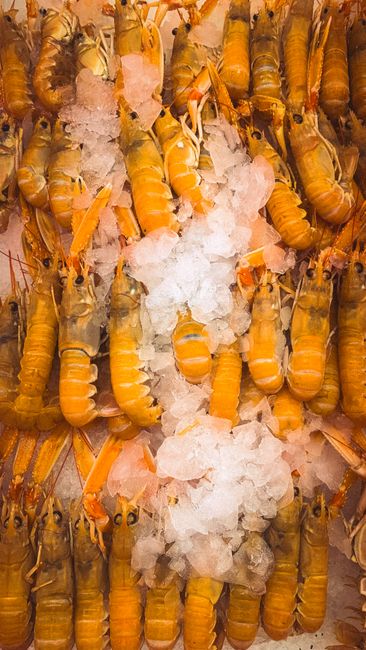
Langoustine (Nephrops norvegicus) is a small marine crustacean related to lobster, also sold as Norway lobster, Dublin Bay prawn, or scampi. It has a slender orange-pink shell, long thin claws, and a tail that yields a small amount of sweet, delicate meat with a texture between shrimp and lobster. Langoustines are caught wild, mostly in the North Atlantic and North Sea, and are almost always sold either live, previously frozen whole, or as frozen raw tail meat, since the meat degrades within hours of the animal dying.
Varieties
Scampi and Dublin Bay prawn are just other common names for the same animal, Nephrops norvegicus, not different varieties. Langoustine should not be confused with true prawns or shrimp, which are different crustacean families with a coarser texture, or with crayfish, which are freshwater and smaller.
Buying tips
Live langoustines should be active with tightly curled tails; a limp, straight tail signals the animal died before purchase and the meat is already breaking down. For frozen product, choose whole langoustines or tails frozen individually (IQF) rather than in a solid block, since block-frozen seafood is more prone to freezer burn and uneven thawing.
Substitutes
Jumbo shrimp or prawns, shell-on — 1:1 by weight
The closest everyday substitute in texture and cooking method, though the flavor is less sweet and complex than langoustine.
Spot prawns — 1:1 by weight
Very close in sweetness and delicacy; often considered the best substitute where available, though usually pricier.
Small lobster tail meat — 1:1 by weight
Firmer and slightly less sweet, but the closest match in overall flavor family since both are true lobster relatives.
Crayfish tails — 1:1 by weight
Smaller and milder; use more pieces to match the same weight since individual crayfish tails are tiny.
Rock shrimp — 1:1 by weight
Dense, slightly sweet meat that holds up well in sauces; shells are hard to remove raw so buy it pre-peeled.
Storage
Live langoustines should be cooked the same day; keep them cold and moist under a damp cloth in the refrigerator, never in fresh water or a sealed bag. Frozen whole langoustines or frozen raw tails keep for up to six months at 0°F (-18°C); thaw overnight in the refrigerator and cook within a day of thawing.
How to use
Cook whole langoustines briefly in boiling salted water or on a hot grill, about 2-4 minutes depending on size, just until the shell turns fully orange-pink. Tail meat can be sautéed in butter for 1-2 minutes per side, poached gently, or used raw in ceviche or crudo if labeled sushi-grade. Overcooking turns the meat rubbery within seconds, so pull it from heat as soon as it turns opaque.
What it pairs with
Pairs well with butter, garlic, lemon, and fresh parsley in classic scampi preparations, and with cream-based sauces over pasta. Also complements light, mineral white wines like Muscadet or Chablis, and simple sides like crusty bread or steamed rice that won't compete with the delicate flavor.
Nutrition
Langoustine is low in fat and calories, with roughly 90-100 calories and about 18-20 grams of protein per 3.5-ounce (100g) serving of cooked meat. It's a good source of selenium and vitamin B12, similar to shrimp and lobster.
FAQ
Is langoustine the same as shrimp?
No. Langoustine is a distinct species more closely related to lobster, with a longer body, thin claws, and a sweeter, more delicate meat than most shrimp.
Why is langoustine so expensive?
It's wild-caught in limited quantities, dies quickly after capture so it can't be farmed or shipped live over long distances easily, and each animal yields only a small amount of tail meat relative to its size.
Can you eat the claws?
Yes, though the meat inside is minimal. Most of the edible meat is in the tail; the claws are typically cracked and sucked or used mainly for stock and bisque.
Do you need to devein langoustine?
Yes, the dark digestive tract runs down the back of the tail just like shrimp, and should be removed before cooking if the langoustine is peeled, or after cooking if serving whole.
Have langoustine on hand? Find recipes with our Recipe Generator →