
Plantains
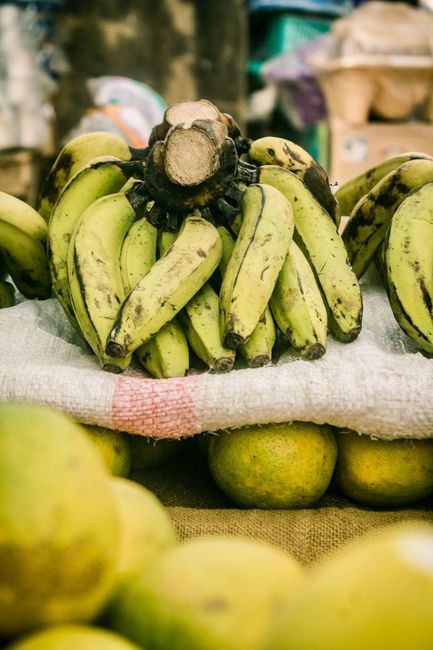
Plantains (called platanos in Spanish) are a starchy relative of the banana, eaten cooked rather than raw at almost every stage. Green plantains are firm and starchy like a potato, yellow plantains are semi-ripe with more sweetness, and black plantains are fully ripe, soft, and much sweeter, closer to caramel than banana. The same fruit is used very differently depending on which stage you buy it at.
Varieties
Plantains are a distinct cultivar group from dessert bananas, bred for cooking rather than eating raw; their higher starch and lower sugar content at the green stage is what makes them behave more like a vegetable than a fruit in savory dishes.
Buying tips
For tostones or savory green plantain dishes, choose plantains that are fully green and rock-hard with no soft spots. For maduros or sweet preparations, look for yellow skin with black speckling; fully black, slightly wrinkled skin signals peak sweetness for baking and frying ripe.
Substitutes
Green bananas — 1:1
Closest texture match for tostones or mashed green plantain dishes, though less starchy and slightly sweeter even when unripe.
Yuca (cassava), peeled and boiled — 1:1 by weight
Good stand-in for green plantain in fried or boiled savory preparations; starchier and blander, so season a bit more.
Sweet potato — 1:1 by weight
Reasonable substitute for ripe plantain in sweet or caramelized side dishes, though it lacks the plantain's slight tang.
Ripe banana (for very ripe plantain in baking) — 3:4
Use about three-quarters the amount of banana since it's softer and wetter than ripe plantain; reduce other liquid in the recipe slightly.
Storage
Store plantains at room temperature to let them ripen; refrigeration slows ripening but can also cause the skin to blacken without the flesh softening properly. Once fully ripe (black skin, soft to the touch), they can be refrigerated for about a week to hold that stage, or peeled and frozen for up to 3 months.
How to use
Green plantains are sliced and fried twice for tostones, or boiled and mashed for mangu and fufu. Yellow, semi-ripe plantains are pan-fried into maduros with a balance of starch and sweetness. Fully black, soft plantains are best baked, grilled, or fried until caramelized, or blended into batters for bread and fritters.
What it pairs with
Green plantains pair well with garlic, lime, and salty proteins like fried pork or beans. Ripe, sweet plantains pair naturally with cinnamon, coconut, and creamy elements like sour cream or crema.
Nutrition
Plantains are higher in starch and calories than bananas, with a good amount of potassium, vitamin C, and vitamin A (especially in riper, more orange-fleshed fruit). They contain more resistant starch when green, which behaves more like a whole grain in digestion.
FAQ
Can plantains be eaten raw?
Green plantains are almost never eaten raw because they're starchy and astringent; even fully ripe black plantains are usually cooked, though very ripe ones can be eaten raw in small amounts since they turn quite sweet.
How long does it take a plantain to ripen?
A green plantain typically takes 1 to 2 weeks at room temperature to turn fully black and soft; placing it in a paper bag with a banana or apple speeds this up by a few days.
Why did my fried plantains turn out tough instead of soft?
This usually means the plantain wasn't ripe enough. Yellow-to-black skin with soft give is needed for maduros; using a firm green plantain for that dish results in a chewy, starchy texture instead.
Are plantains and bananas interchangeable in recipes?
Not directly. Plantains have far less sugar and more starch, so they need to be cooked in nearly all preparations, while bananas can be used raw or cooked and are noticeably sweeter and softer at a similar stage of ripeness.
Have plantains on hand? Find recipes with our Recipe Generator →