
Riblets
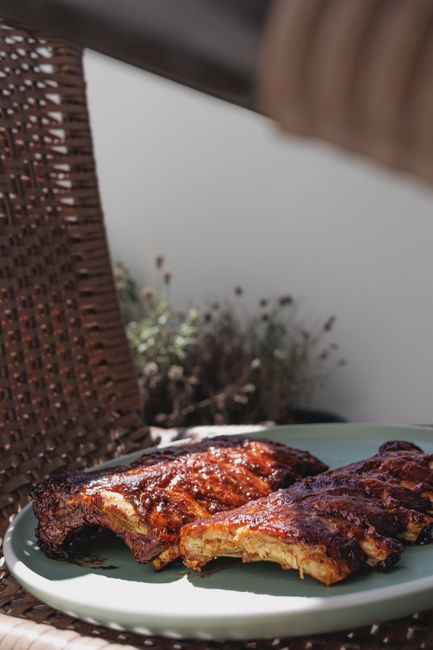
Riblets are the meaty rib tips and short cross-cut pieces left over when a butcher trims a full slab of spare ribs into a neat, uniform rack for retail sale. They're cut either lengthwise into short strips or crosswise across the bones into 1 to 2 inch segments, so each riblet has a bit of bone, cartilage, and meat rather than one long clean rib. Pork riblets are the most common, though beef riblets (cut from the plate or short rib section) show up in some markets, especially for Korean-style kalbi.
Varieties
Pork riblets (from spare ribs) are the standard cut in most US markets and grocery stores. Beef riblets, cut across the plate or short rib section, are thinner, chewier, and common in Korean and some Chinese preparations; they cook faster than pork riblets due to less connective tissue per piece.
Buying tips
Look for riblets with visible marbling and a moderate amount of meat between bones rather than mostly fat or cartilage. If a butcher counter doesn't stock them, ask for spare rib tips or request a rack of spare ribs cut into riblets on the spot.
Substitutes
Pork spare rib tips — 1:1
Nearly identical cut, sometimes sold separately as 'rib tips' at the same counter; slightly more cartilage than riblets from the main rack.
Baby back ribs, cut into short pieces — 1:1
Leaner and more tender than riblets, with less connective tissue, so they cook a bit faster.
Country-style ribs, cut smaller — 1:1
Meatier and closer to shoulder chops than true ribs; good flavor but a different texture since there's little to no rib bone.
Chicken wings or drumettes — 1:1
A common swap for saucy, oven-baked riblet recipes; cooks faster and needs less braising time to become tender.
Beef short ribs, cut into 1-inch pieces — 1:1
Works for beef riblet recipes like kalbi; richer flavor and needs a longer braise or a hot quick grill with thin-cut pieces.
Storage
Keep raw riblets refrigerated and use within 2 to 3 days, or freeze in a sealed bag for up to 6 months. Cooked riblets keep in an airtight container in the refrigerator for 3 to 4 days and reheat well in a covered dish in a 300°F oven.
How to use
Riblets are best cooked low and slow first, either braised, simmered, or slow-baked covered for 60 to 90 minutes, until the connective tissue softens, then finished uncovered under a broiler or on a grill with sauce to caramelize the surface. They're a natural fit for sticky glazes: barbecue sauce, Chinese-style hoisin and five-spice glazes, and Korean gochujang or soy-based marinades.
What it pairs with
Pairs well with sweet-tangy glazes (barbecue sauce, plum sauce, honey-soy), pickled vegetables or slaw to cut the richness, and simple starches like rice or cornbread that soak up extra sauce.
Nutrition
Pork riblets are fattier than a lean loin cut, since they include skin, bone, and connective tissue proportional to meat; a 3-ounce cooked serving runs roughly 250 to 300 calories with a solid dose of protein and B vitamins.
FAQ
Are riblets the same as spare ribs?
No. Riblets are the shorter, uneven pieces cut off during the trimming of a full slab of spare ribs into a neat rack, or the whole rack cut crosswise into short segments; spare ribs are the long, intact bones.
Do riblets need to be boiled before baking or grilling?
Not required, but simmering them in water or broth for 20 to 30 minutes before finishing on the grill or under a broiler speeds up tenderizing and reduces the total cook time significantly.
Why are my riblets tough after cooking?
Riblets contain more connective tissue than a clean rib cut and need low, slow, moist heat (braising or covered baking at 300 to 325°F for at least an hour) to break down; cooking them quickly at high heat like a steak leaves them chewy.
Can riblets be made ahead and frozen after cooking?
Yes, braised or baked riblets freeze well for up to 3 months in a sealed container with some of their cooking liquid or sauce to keep them from drying out during reheating.
Have riblets on hand? Find recipes with our Recipe Generator →