
Spatchcock
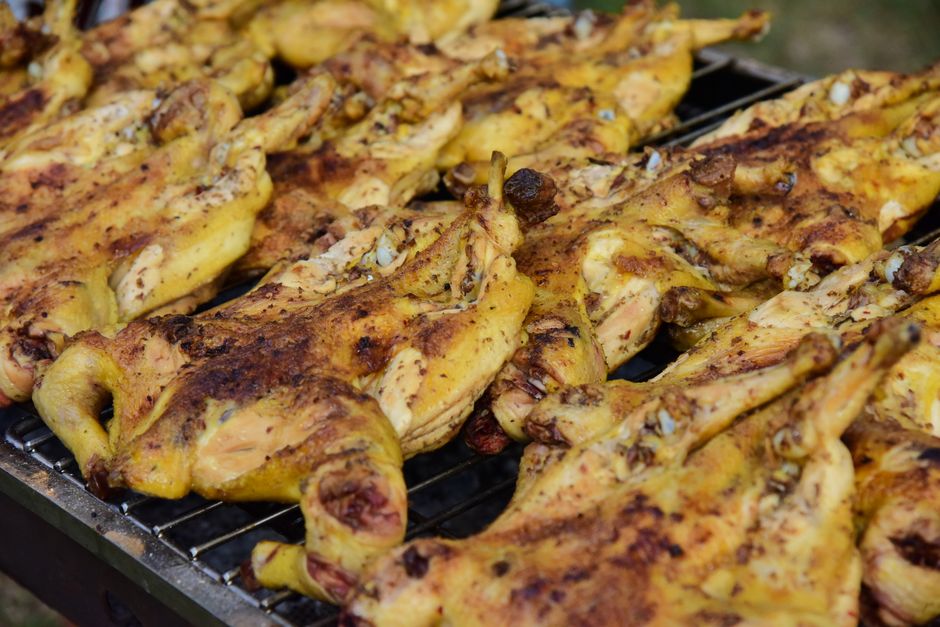
Spatchcocking (also called butterflying) is a technique for preparing whole poultry, most often chicken or turkey, by cutting out the backbone with shears or a knife and pressing the breastbone down until the bird lies flat. It exposes more skin surface area and puts the breast and thighs roughly the same distance from the heat, so the whole bird finishes cooking at close to the same time instead of the breast drying out while the legs catch up.
Varieties
Turkey spatchcocking follows the same cut as chicken but requires cutting through much thicker rib bones, so sturdy poultry shears (not kitchen scissors) are necessary, and the flattened bird may need a lower oven rack to fit.
Buying tips
A whole chicken between 3.5 and 4.5 pounds spatchcocks most evenly and fits most home ovens once flattened. Turkeys and larger birds need sturdy poultry shears strong enough to cut through rib bones rather than standard kitchen scissors. Many butchers and grocery meat counters will spatchcock a bird for free if asked at the time of purchase.
Substitutes
Half-split through the breastbone — n/a
Splitting the bird into two symmetrical halves along the spine and breastbone cooks nearly as fast as spatchcocking and only requires a sharp chef's knife instead of poultry shears.
Cut into 8 parts (breasts, thighs, legs, wings) — n/a
Individual parts cook faster and more evenly than a whole bird, but the presentation of a whole roasted bird is lost.
Traditional trussed whole roast — n/a
Takes roughly 25 to 40 percent longer in the oven than a spatchcocked bird and more often overcooks the breast before the thighs reach a safe internal temperature.
Storage
Raw spatchcocked poultry is stored the same as any raw bird: on a plate or in a shallow container, loosely covered, on the coldest shelf of the refrigerator for up to 2 days before cooking. After cooking, carve the meat, let it cool within two hours, and refrigerate in an airtight container for 3 to 4 days.
How to use
Spatchcocking is used mainly on whole chickens, turkeys, Cornish hens, and quail before grilling, roasting, or smoking. Flattening the bird shortens cook time and lets a dry rub, marinade, or compound butter reach more of the surface, since the skin lies open instead of curving around a rounded carcass.
What it pairs with
Because so much skin is exposed, spatchcocked poultry pairs well with dry spice rubs, compound butter slid under the loosened skin, and high-heat roasting around 425 to 450°F that crisps the surface quickly. Citrus, garlic, and herb pastes worked directly under the skin flavor the meat itself rather than just seasoning the surface.
Nutrition
Spatchcocking doesn't change the nutritional content of the meat itself, since no meat is removed, only the backbone (about 1 to 2 ounces on a chicken). It does increase the ratio of crisp skin to meat on the plate, since more surface area browns during roasting.
FAQ
What does spatchcock actually mean?
It refers to removing a bird's backbone with shears or a knife and pressing the breastbone down to flatten the whole bird into one even layer for cooking.
Does spatchcocking a chicken really cook faster?
Yes. A spatchcocked 4-pound chicken typically roasts in about 40 to 50 minutes at 450°F, compared to 60 to 75 minutes for the same bird roasted whole and trussed.
Can you spatchcock a turkey the same way as a chicken?
Yes, the cut is identical, but turkey backbones and ribs are much thicker, so sturdy poultry shears or a heavy knife work better than kitchen scissors.
What do you do with the backbone after spatchcocking?
Freeze it along with other bones and vegetable scraps to make stock; a single chicken backbone plus a few scraps is enough for a flavorful small batch of broth.
Do you need special tools to spatchcock a bird?
A pair of sturdy kitchen shears is enough for a chicken; a sharp chef's knife can work as a backup, and turkeys are easier with dedicated poultry shears.
Have spatchcock on hand? Find recipes with our Recipe Generator →