
Steak
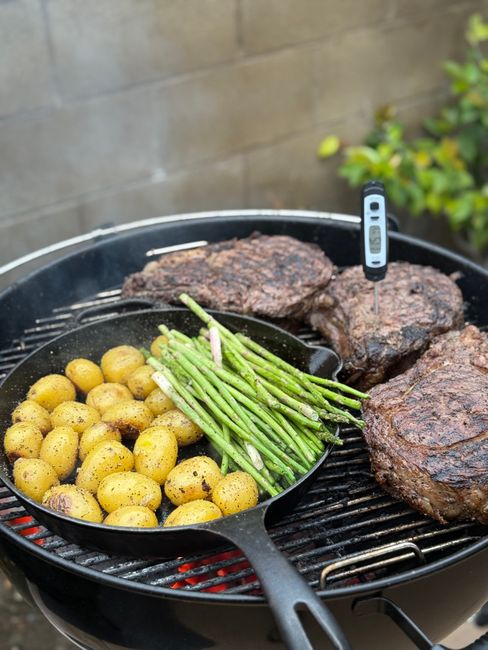
Steak is a cut of beef muscle, and its finished quality depends almost entirely on internal temperature at the moment it's pulled from heat. Unlike most proteins, steak has a wide, deliberate range of acceptable doneness, from cool and red in the center to fully cooked through, and the exact temperature you pull it at determines texture, juiciness, and color far more than the seasoning or sear does.
Varieties
Leaner cuts like filet mignon and sirloin dry out and toughen faster past medium, so they're best kept at rare to medium. Well-marbled cuts like ribeye and New York strip stay juicy even at medium to medium-well because the rendering fat continues to baste the muscle from within.
Buying tips
Choose steaks at least 1 inch thick if precise temperature control matters to you; thin steaks swing from rare to well-done in under a minute and are harder to pull at an exact target. Look for even marbling (thin white flecks of fat running through the muscle) rather than large fat pockets, and let the steak come closer to room temperature for 30-45 minutes before cooking so the center doesn't lag far behind the surface temperature.
Substitutes
Sirloin (in place of ribeye) — 1:1 by weight
Leaner and less forgiving of overcooking; pull it 5°F earlier than you would a fattier cut like ribeye to avoid dryness.
Flat iron (in place of strip steak) — 1:1 by weight
Similar tenderness and marbling to strip steak but usually thinner, so it reaches target temperature faster and needs closer monitoring.
Filet mignon (in place of ribeye) — 1:1 by weight
Very lean with almost no marbling, so it's best served no further than medium since there's no fat left to keep it moist past that point.
Storage
Raw steak keeps 3 to 5 days in the coldest part of the refrigerator, ideally on a plate or tray to catch drips. For longer storage, wrap tightly in plastic and freeze for up to 6 to 12 months; vacuum-sealed steak keeps closer to a year without freezer burn. Cooked steak keeps 3 to 4 days refrigerated in an airtight container.
How to use
Internal temperature is the only reliable way to hit a target doneness, since color and touch vary by cut and thickness. Rare is 120-125°F, medium-rare is 130-135°F, medium is 140-145°F, medium-well is 150-155°F, and well-done is 160°F and above. Pull the steak 5°F below your target, since carryover cooking (the residual heat still moving through the meat) raises the internal temperature during the rest. A thick cut like a 1.5-inch ribeye can carry over as much as 5-7°F; a thin cut like skirt steak may carry over only 1-2°F. Always insert the thermometer horizontally into the thickest part of the steak, avoiding bone and any fat pockets, which read hotter or cooler than the actual muscle.
What it pairs with
Compound butter, chimichurri, or a red wine pan sauce all complement steak without masking the doneness you worked for. Roasted potatoes, charred greens, or a simple green salad balance the richness, especially with well-marbled cuts cooked closer to medium-rare.
Nutrition
A 3-ounce cooked serving of steak provides roughly 22-25 grams of protein along with iron, zinc, and vitamin B12. Leaner cuts like sirloin and filet have less saturated fat than well-marbled cuts like ribeye, though cooking temperature doesn't change the nutritional content, only texture and moisture.
FAQ
What temperature is medium-rare steak?
130-135°F measured in the center after resting. Pull it from heat around 125-130°F to account for carryover cooking.
Is it safe to eat steak rare?
Whole cuts of steak are safe at rare temperatures (120-125°F) because bacteria live on the surface, not inside the muscle, and searing kills surface bacteria. This doesn't apply to ground beef, which must reach 160°F throughout.
Why does my steak keep cooking after I take it off the heat?
Carryover cooking happens because the outer layers of the steak are hotter than the center and continue transferring heat inward during the rest. Thicker, denser cuts carry over more than thin ones.
How long should steak rest before cutting?
5 to 10 minutes for a standard 1 to 1.5-inch steak, tented loosely with foil. Resting lets juices redistribute; cutting immediately releases most of them onto the board instead of staying in the meat.
Can I check steak doneness without a thermometer?
The touch test (comparing firmness to the fleshy pad below your thumb at different finger positions) works with practice but is far less reliable than an instant-read thermometer, especially for thick or irregularly shaped cuts.
Have steak on hand? Find recipes with our Recipe Generator →