
Taffy
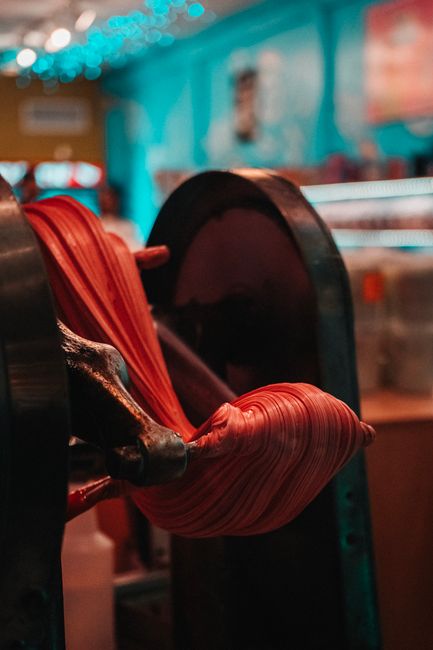
Taffy is a chewy candy made by boiling sugar, butter, and flavoring to the firm-ball stage, then repeatedly pulling and stretching the mass until it aerates, lightens in color, and develops its signature elastic chew. Saltwater taffy, the boardwalk version most people know, doesn't actually contain seawater; the name is a marketing legend from Atlantic City. Taffy differs from caramel mainly in how much air gets worked into it during pulling, which is what gives it a lighter texture instead of a dense, sticky one.
Varieties
Saltwater taffy is the light, aerated boardwalk style pulled to incorporate air. Molasses taffy (also called taffy pulls or candy pulls, historically made at taffy-pulling parties) is denser and darker, made with molasses instead of just sugar syrup, and has a stronger, slightly bitter-sweet flavor. Both are pulled candies, but molasses taffy is chewier and less airy.
Buying tips
Fresh taffy should feel pliable but not sticky through the wrapper; if pieces feel rock-hard, they're old and have dried out. Buy from shops with visible turnover (boardwalk and seaside candy stores that make it in-house) rather than taffy that's been sitting in a bin for months, since staleness is the main quality issue.
Substitutes
Soft caramel candies, unwrapped and warmed briefly — 1:1 by weight
Caramel is denser and stickier than taffy since it isn't pulled and aerated, but it melts and layers similarly in baked goods or as a topping.
Fruit chews (like Starburst) melted slightly — 1:1 by weight
Closest match for flavor variety and chew in recipes like taffy apples, though the flavor is more artificial-fruit than the classic vanilla or mint taffy notes.
Homemade butterscotch or vanilla caramel, pulled by hand until light in color — 1:1 by weight
Requires pulling the candy yourself to lighten the color and texture, but gets closest to real taffy chew if none is available to buy.
Marshmallow creme mixed with a few crushed hard candies — Use to taste, not a direct swap
Not a true substitute, but works in a pinch for a soft, chewy topping when neither taffy nor caramel is on hand.
Storage
Keep taffy in a cool, dry spot away from direct sunlight and heat, ideally between 60 and 70°F. Humidity makes it sticky and soft, while heat makes pieces fuse together into one mass. Wrapped taffy keeps well for 2 to 3 months at room temperature; unwrapped or homemade taffy should go in an airtight container with wax paper between layers and is best eaten within a few weeks, since it dries out and hardens over time.
How to use
Taffy is eaten straight as candy, but it also shows up melted into taffy apples, chopped and folded into ice cream or blondies for pockets of chew, and pulled thin as a decorative garnish on cakes and pastries. Because it softens quickly with heat, it melts more evenly than hard candy when used as a coating.
What it pairs with
Pairs well with tart apples (classic taffy apples), vanilla ice cream, and salty snacks like pretzels or popcorn, which balance its heavy sweetness. Mint and chocolate taffy flavors work particularly well folded into brownie or blondie batter.
Nutrition
Taffy is essentially sugar, corn syrup, and butter or vegetable fat, so it's calorie-dense with little nutritional value beyond quick energy from sugar. A single piece is typically 20 to 35 calories, most of it sugar.
FAQ
Does saltwater taffy actually contain salt water?
No. It's a sugar, corn syrup, and butter candy; the name originated as an Atlantic City marketing story from the late 1800s and has nothing to do with the recipe.
Why does homemade taffy sometimes turn out grainy instead of smooth?
Grainy taffy usually means sugar crystals formed during cooking, often from stirring the syrup too much or not brushing down sugar crystals from the sides of the pot with a wet pastry brush while it boils.
Can taffy be melted down and reused in baking?
Yes, taffy melts smoothly in a double boiler or microwave in short bursts and can be stirred into batters or drizzled as a topping, similar to soft caramel.
Why does taffy get hard after a few weeks even when wrapped?
Taffy loses moisture over time even in its wrapper, and once enough evaporates the sugar structure stiffens. Storing it in an airtight container slows this considerably.
Have taffy on hand? Find recipes with our Recipe Generator →