
Unagi
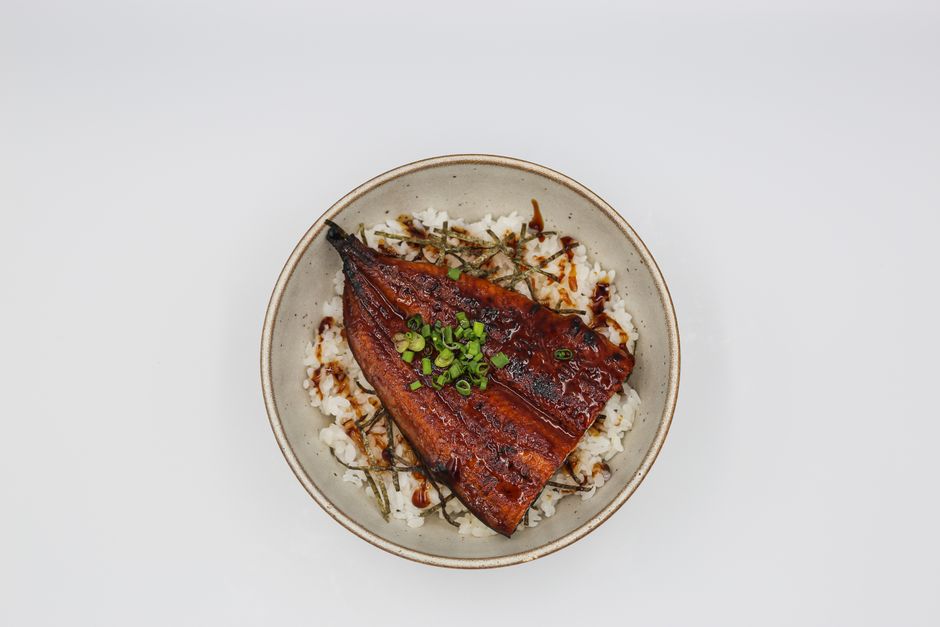
Unagi is freshwater eel, most commonly prepared in Japanese cooking by butterflying, deboning, steaming or grilling, and basting with a sweet-savory soy, mirin, and sugar glaze called kabayaki sauce. It has a rich, fatty texture closer to a good piece of fish belly than to any land protein, with a mild flavor that's carried almost entirely by the glaze. In the US it's most often sold frozen, pre-cooked, and vacuum-sealed, ready to reheat rather than cooked from raw.
Varieties
Unagi refers specifically to freshwater eel (genus Anguilla); anago is a related but distinct saltwater conger eel often confused with it on sushi menus, and while both are prepared with kabayaki sauce, anago is leaner and slightly more delicate.
Buying tips
Look for frozen kabayaki unagi imported from Japan or Taiwan, sold in vacuum-sealed packs at Asian grocery stores; check that the flesh looks glossy and dark brown rather than dried out or gray at the edges. Farmed eel dominates the market since wild eel populations are heavily overfished, so farmed is the standard and not a lesser option here.
Substitutes
Anago (saltwater conger eel) — 1:1 by weight
Leaner and lighter in flavor than unagi, but prepared the same way with kabayaki sauce; the closer substitute in technique and appearance, though texture is less rich.
Smoked eel — 1:1 by weight
Already cooked and flavorful on its own; warm gently rather than grilling hard, since it's more delicate and already has a pronounced smoky taste the sauce needs to complement rather than mask.
Catfish fillet, kabayaki-style — 1:1 by weight
Freshwater and mildly fatty like unagi; butterfly, grill skin-side down, and baste repeatedly with kabayaki sauce to build the same lacquered glaze.
Salmon belly or fatty fillet, kabayaki-style — 1:1 by weight
Higher fat content gives a similar richness to unagi, though the flavor reads more distinctly like salmon under the glaze.
Plant-based or imitation unagi (konjac or fish-paste based) — 1:1 by package weight
Sold frozen in some Asian grocery stores, pre-glazed; texture is softer and less fatty than real eel, but works in unadon for a vegetarian version.
Storage
Frozen pre-cooked unagi keeps well for several months unopened. Once thawed, use within a day or two, wrapped tightly in the refrigerator. Fresh raw eel is highly perishable and should be cooked the same day it's purchased.
How to use
Most commonly served as unadon or unaju (over rice in a bowl or lacquered box), in unagi sushi (nigiri or rolls), or in hitsumabushi, a Nagoya-style dish where the eel and rice are divided into portions eaten three different ways. Reheat pre-cooked vacuum-sealed unagi by steaming briefly or warming in a covered skillet with a splash of water, then finishing under a broiler with extra kabayaki sauce to re-crisp the glaze.
What it pairs with
Pairs with steamed short-grain rice, pickled daikon or gari, a light miso soup, and a scattering of sansho pepper or thin-sliced scallion to cut the richness of the glaze.
Nutrition
Unagi is high in fat, including omega-3s, and a good source of vitamin A and vitamin B12, but it's also calorie-dense and typically served with a sugar-heavy glaze, so portions in restaurants tend to be small.
FAQ
Why is unagi always sold pre-cooked and frozen?
Raw eel blood contains a toxin that's neutralized by cooking, and eel is also difficult to fillet and prepare safely at home, so almost all unagi sold outside professional kitchens is pre-cooked, glazed, and frozen for reheating.
Is unagi the same as eel sushi?
Unagi sushi uses freshwater eel prepared kabayaki-style; some sushi restaurants substitute anago (saltwater conger eel) instead, which looks similar but has a milder, leaner flavor.
Why is unagi becoming more expensive?
Wild eel populations, especially the Japanese eel used for farming juveniles, have declined sharply, and eel farming still depends on catching wild young eels (glass eels) rather than full captive breeding, which has driven prices up significantly over the past decade.
Can you make kabayaki sauce at home?
Yes. A basic version simmers equal parts soy sauce, mirin, and sugar with a little sake until it thickens slightly into a glaze, then it's brushed onto the fish repeatedly while grilling or broiling.
Have unagi on hand? Find recipes with our Recipe Generator →