
Yamagobo
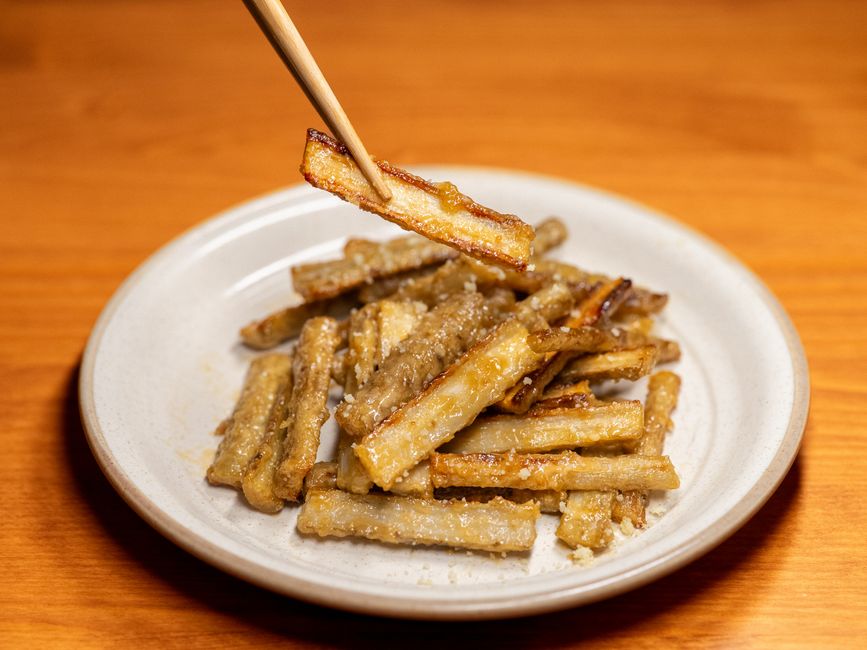
Yamagobo is pickled burdock root (gobo), typically dyed a vivid yellow and packed in a sweet-tangy vinegar brine. The root itself is long, slender, and fibrous with an earthy, faintly bitter flavor that mellows into a crunchy, tart-sweet pickle once cured. It's sold pre-sliced into long strips or as whole roots in vacuum-sealed pouches, mainly for use in sushi rolls, where a single strip runs down the center of the roll for color and crunch rather than as a dominant flavor.
Varieties
Yamagobo sold in Japanese grocery stores is almost always cultivated burdock root (Arctium lappa) that's been dyed and pickled; the name literally means 'mountain burdock,' but it's not a wild mountain vegetable in most commercial products. Some artisanal versions use less coloring and stay a duller tan, which is closer to the root's natural cured color.
Buying tips
Look for strips that are uniformly yellow without dull or grayish patches, and check that the brine is clear rather than cloudy. Whole-root packages let you control the slice thickness for rolls; pre-sliced packages save time but the strips are sometimes inconsistent in width.
Substitutes
Takuan (pickled daikon) — 1:1 by weight, sliced into similar strips
Milder and less earthy than yamagobo, with a similar crunchy-tangy bite and a matching bright yellow color for sushi rolls.
Fresh burdock root, simmered in vinegar and sugar — 1:1 by weight once cooked and cooled
Closest flavor match since it's the same root; simmer thin strips in a mix of rice vinegar, sugar, and a pinch of turmeric for color if a yellow tint is wanted.
Pickled carrot strips — 1:1 by weight
A common vegetarian sushi-bar substitute for color and crunch, though it lacks burdock's earthy undertone.
Bettarazuke (sweet pickled daikon) — Use to taste, not a direct swap
Much sweeter and softer in texture than yamagobo, so it changes the character of a roll rather than mimicking it; best in dishes where yamagobo's crunch isn't essential.
Storage
Unopened vacuum-sealed yamagobo keeps for months at room temperature or in the refrigerator; check the package date. Once opened, store submerged in its own brine in an airtight container in the refrigerator and use within one to two weeks. Discard if the brine turns cloudy or develops an off smell.
How to use
Most commonly sliced into thin strips and rolled into the center of sushi maki (yamagobo maki), often alongside or as an alternative to kanpyo. Also served sliced thin as a small side pickle (tsukemono), chopped into rice mixes, or added to bento boxes for color and a firm, crunchy texture that holds up next to soft rice and fish.
What it pairs with
Works well with sushi rice, nori, cucumber, and avocado in vegetarian rolls, and pairs naturally with pickled ginger and soy sauce as a table condiment. Its crunch also balances soft fillings like tamago or cream cheese in specialty rolls.
Nutrition
Yamagobo is low in calories and fat but higher in sugar and sodium than fresh burdock root because of the sweet vinegar brine. Burdock root itself contributes inulin, a prebiotic fiber, though much of that fiber content is retained even after pickling.
FAQ
Is yamagobo the same as gobo?
Gobo is the raw burdock root itself; yamagobo specifically refers to that root after it's been pickled, usually dyed yellow, and cut into strips.
Why is yamagobo dyed yellow?
The dye (traditionally turmeric, now sometimes food coloring) makes the pickle visually distinct in sushi rolls and mimics the look of takuan, which many diners expect from a yellow pickled strip.
Does yamagobo need to be cooked before eating?
No. It's fully cured during pickling and is ready to eat straight from the package, sliced as needed.
Can yamagobo be frozen?
Freezing is not recommended; it breaks down the texture and the pickle turns mushy and watery once thawed.
Have yamagobo on hand? Find recipes with our Recipe Generator →