
Easter Egg Dye Recipe Using Food Coloring
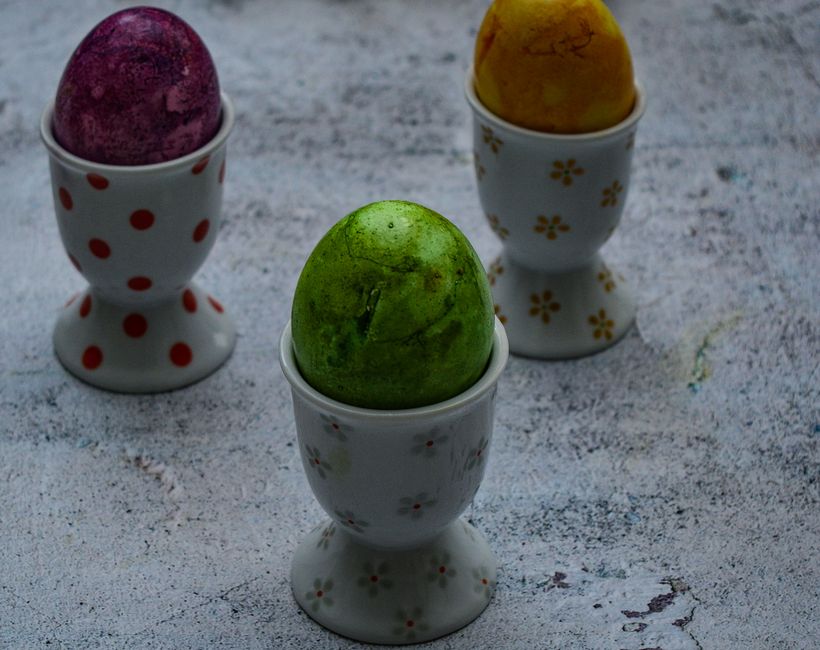
Vinegar lowers the pH of the dye bath, which etches the eggshell's calcium carbonate just enough for the food coloring to bond to it instead of sliding off, so colors go on more evenly and don't rub away once the eggs dry.
- Prep
- 15 min
- Cook
- 15 min
- Total
- 45 min
- Servings
- 12
Ingredients
- 12 large eggs eggs, hard-boiled and cooled
- 4 1/2 cups water, very hot (not boiling)
- 6 tsp white vinegar
- 90 drops liquid food coloring (assorted colors)
Nutrition per serving
- Calories
- 73
- Protein
- 6g
- Carbs
- 0g
- Fat
- 5g
Based on the recipe as written, one serving. Recalculates if you swap an ingredient above. An estimate only, exact values depend on the specific ingredients used.
Need different units or a different yield? Try our Conversion Calculator →
Instructions
- 1Hard boil the eggs: cover eggs with cold water in a saucepan, bring to a boil, then cover and remove from heat for 12 minutes. Transfer to an ice bath and let cool completely, then pat dry.
- 2For each color, pour 3/4 cup very hot water into a mug or small bowl, add 1 teaspoon white vinegar, and stir in 10 to 20 drops of food coloring depending on how bold you want the shade.
- 3Using a spoon or tongs, lower a cooled, dry egg into the dye bath so it's fully submerged.
- 4Leave the egg in the dye for 2 to 3 minutes for a pastel tint, or up to 8 to 10 minutes for a deep, saturated color, turning it once or twice so the color coats evenly.
- 5Lift the egg out and set it on a wire rack or empty egg carton to air-dry completely before handling, about 15 to 20 minutes.
- 6For two-tone or marbled eggs, dip a dry egg in one color, let it dry fully, then dip half of it in a second color.
Tips & variations
- White-shelled eggs show the truest, brightest colors; brown-shelled eggs still take dye but the colors come out muted and earthier since the dye layers over a darker base.
- For a deeper color without a longer soak, double the vinegar to 2 teaspoons per 3/4 cup water.
- Rubber bands wrapped around a dry egg before dipping create clean stripes once removed.
- A few drops of vegetable oil swirled into a finished dye bath and briefly rolled over a dry egg gives a marbled, glossy finish.
- Mix two primary colors in the same bath (a few drops of blue plus a few drops of yellow) to create custom shades like teal or olive.
Storage & reheating
If the eggs are meant to be eaten, refrigerate them as soon as they're dry and use within one week, the same window as any hard-boiled egg. Eggs dyed for display only should still be refrigerated if they were boiled, since cooked eggs left at room temperature for more than two hours aren't safe to eat later.
Tips from the Tulo kitchen
- Add a splash of dish soap to the dye water and it beads up and rolls off the shell instead of coating it evenly, so skip that step even though some old tips suggest it.
- Dyeing eggs cold from the fridge causes the dye bath to cool down fast and slows coloring considerably; let eggs come closer to room temperature first.
- Line the dyeing area with newspaper or a silicone mat, liquid food coloring stains grout and wood countertops almost immediately.
FAQ
Can I use regular liquid food coloring instead of store-bought egg dye tablets?
Yes. Liquid food coloring mixed with hot water and vinegar works the same way commercial dye tablets do, since the tablets are just citric acid and dye. Gel food coloring also works but needs to be stirred in well since it dissolves more slowly.
Why isn't the dye sticking to my eggs?
This usually means there wasn't enough vinegar in the bath or the eggs still had a light film of oil or residue on the shell. Wipe eggs with a bit of vinegar on a paper towel before dyeing if colors are coming out patchy.
Does the vinegar make the eggs taste different?
Only faintly, and only right at the shell surface. Peeling the egg before eating removes any trace of vinegar flavor entirely.
How long do dyed hard-boiled eggs last in the fridge?
Up to one week, the same as any hard-boiled egg, as long as they went straight into the refrigerator once dry and weren't left out at room temperature for more than two hours at a stretch.
Can I dye raw eggs instead of hard-boiled ones?
Raw eggs can be dyed the same way, but they need to be handled carefully since a cracked raw egg leaks dye and can't be saved for eating. Most people boil eggs first so the dyed eggs are ready to eat or display without extra risk.