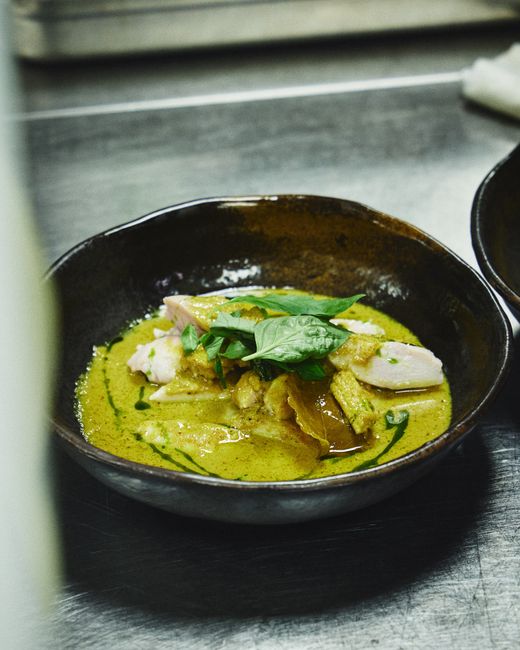
Tom Yum Soup Recipe

Bruising the lemongrass, galangal, and lime leaves before simmering them, rather than leaving them whole and untouched, ruptures their oils into the broth, which is what gives tom yum its sharp, unmistakably fragrant base.
- Prep
- 15 min
- Cook
- 20 min
- Total
- 35 min
- Servings
- 4
Ingredients
- 6 cups chicken or shrimp stock
- 3 stalks lemongrass stalks, smashed and cut into 2-inch pieces
- 1 oz galangal, sliced (or fresh ginger)
- 5 leaves kaffir lime leaves, torn
- 3 chilies Thai chilies, smashed
- 1 lb medium shrimp, peeled and deveined (shells reserved)
- 6 oz cremini or straw mushrooms, halved
- 3 tbsp fish sauce
- 1/4 cup fresh lime juice
- 2 tbsp Thai chili paste (nam prik pao)
- 1 cup cherry tomatoes, halved
- 1/4 cup cilantro leaves, for garnish
Need different units or a different yield? Try our Conversion Calculator →
Instructions
- 1If using shrimp shells, simmer them in the stock for 10 minutes to build extra flavor, then strain and discard the shells, or skip this if using plain stock.
- 2Bring the stock to a simmer and add the smashed lemongrass, galangal, kaffir lime leaves, and Thai chilies.
- 3Simmer for 10 minutes to infuse the broth, keeping it at a gentle simmer rather than a hard boil.
- 4Stir in the chili paste and mushrooms and simmer 3-4 minutes, until the mushrooms soften.
- 5Add the shrimp and cherry tomatoes and cook 2-3 minutes, just until the shrimp turn pink and curl.
- 6Remove from heat and stir in the fish sauce and lime juice.
- 7Taste and adjust, adding more fish sauce for saltiness, lime juice for sourness, or chili paste for heat.
- 8Ladle into bowls and garnish with cilantro leaves.
Tips & variations
- Tom yum comes in a clear version (tom yum nam sai) and a creamy version (tom yum nam khon) made with a splash of evaporated milk or coconut milk stirred in at the end, both are traditional.
- Swap the shrimp for chicken, mixed seafood, or mushrooms alone for a vegetarian version, using vegetable stock and soy sauce in place of fish sauce.
- Frozen galangal and kaffir lime leaves, found at most Asian grocers, work just as well as fresh and are worth stocking for this soup.
- No nam prik pao chili paste, a spoonful of tomato paste with a pinch of extra chili gets closer than omitting it entirely.
Storage & reheating
Refrigerate up to 2 days, though the shrimp continue firming up over time. Reheat gently over low heat without boiling, and add a fresh squeeze of lime juice after reheating since its brightness fades in storage. Not recommended for freezing, the shrimp texture suffers.
Nutrition
A light, brothy soup, the shrimp provide lean protein while the broth itself is low in fat.
Tips from the Tulo kitchen
- Smash the lemongrass, galangal, and chilies with the flat of a knife before adding them, bruising the aromatics releases far more flavor than dropping them in whole.
- The lemongrass, galangal, and lime leaves are meant to be fished out or left in the bowl uneaten, warn guests rather than let them bite into a woody stalk.
FAQ
What can I use instead of galangal?
Fresh ginger is the most common substitute, though it has a milder, sweeter flavor than galangal's sharper, more citrusy and peppery profile.
Do I eat the lemongrass and lime leaves?
No, they're simmered for flavor and traditionally left in the bowl to be pushed aside rather than eaten, they're too woody and fibrous to chew.
What is nam prik pao and can I skip it?
It's a Thai roasted chili paste that adds smoky depth and a touch of sweetness, you can skip it, but the soup will taste flatter and less complex without it.