
What Is Mezcal?
Mezcal is a smoky Mexican spirit distilled from the roasted hearts of agave plants. Unlike tequila, which must be made from blue Weber agave, mezcal can be made from more than 30 different agave species, giving it a much wider range of flavor.
More detail
The defining step in mezcal production is roasting: agave hearts (piñas) are cooked for several days in underground pits lined with volcanic rock and wood, which is where the spirit's signature smokiness comes from. After roasting, the piñas are crushed (often by a stone wheel pulled by a horse or mule), fermented in open-air vats, then distilled, usually twice, in small clay or copper stills. Most mezcal is still made by hand in small batches, largely in Oaxaca, though other Mexican states including Guerrero, Durango, and Michoacán also produce it under the same designation of origin.
Where it's used
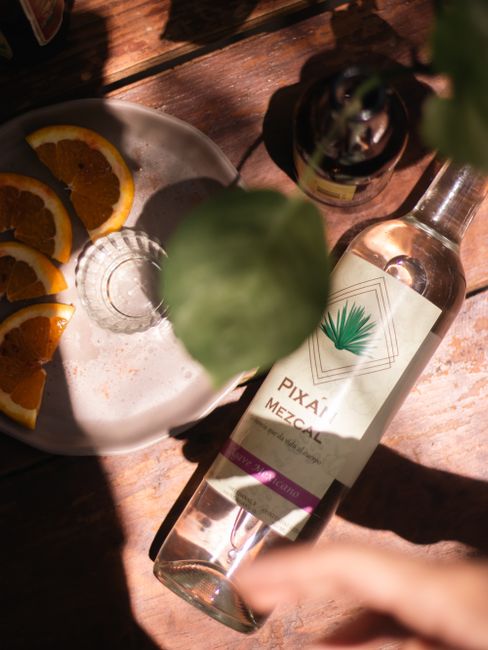
Mezcal is traditionally sipped neat, often alongside a wedge of orange dusted with sal de gusano (a chile-salt blend that sometimes includes ground agave worm), rather than shot back. It's also used in cocktails, most commonly swapped for tequila in a margarita, or in mezcal-forward drinks like the Oaxaca Old Fashioned. Bottles are typically labeled joven (unaged), reposado (aged a few months in wood), or añejo (aged a year or more), which affects both color and flavor intensity.
Substitutes
Tequila is the closest substitute in cocktails calling for mezcal, but it won't bring the smoky, earthy character that defines mezcal; expect a cleaner, more straightforward agave flavor instead.
FAQ
What's the difference between mezcal and tequila?
Tequila must be made only from blue Weber agave and is typically produced with steam-cooked agave in ovens, while mezcal can be made from dozens of agave varieties roasted in underground pits, which gives mezcal its smoky flavor that tequila lacks.
Does all mezcal have a worm in the bottle?
No. The worm-in-the-bottle tradition is mostly a marketing gimmick from lower-end brands aimed at tourists; most quality mezcal is bottled without one.
Is mezcal stronger than tequila?
Alcohol content is similar, usually 40-50% ABV for both, but mezcal's smoky, complex flavor can make it taste more intense even at the same proof.
How should mezcal be served?
Traditionally it's sipped slowly at room temperature in a small clay cup called a copita, rather than chilled or shot, to let its smoky and vegetal flavors come through.