
Asiago
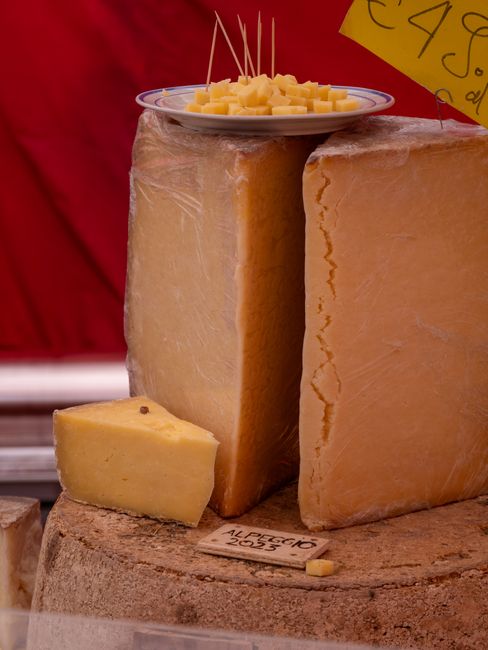
Asiago is an Italian cow's milk cheese from the Veneto and Trentino regions, sold in two very different forms. Asiago Pressato (fresh) is young, semi-soft, mild, and springy, similar in texture to a young provolone. Asiago d'Allevo (aged) is firmer, sharper, and more granular, closer to Parmesan the longer it's aged, and it's the version most often grated over food.
Varieties
Asiago Pressato and Asiago d'Allevo are legally distinct products under Italy's DOP designation, not just different ages of the same cheese; Pressato is made for quick consumption while d'Allevo is aged a minimum of several months up to over a year. Much of the 'Asiago' sold outside the EU is domestic (often American-made) and tends to be milder and less complex than DOP versions from Italy.
Buying tips
Check the rind and label: Asiago Pressato (fresh) is pale, smooth, and springy; Asiago d'Allevo (aged) has a darker, harder rind and a crumbly interior with small holes. For grating, buy aged Asiago labeled 'stagionato' (aged) or 'oltre i 10 mesi' (over 10 months) rather than the fresh block, which won't grate cleanly.
Substitutes
Parmesan (Parmigiano-Reggiano) — 1:1
Best match for aged Asiago in grated or shaved applications; slightly saltier and more intensely savory.
Grana Padano — 1:1
Milder and less salty than Parmesan, a close stand-in for medium-aged Asiago.
Fontina — 1:1
Good substitute for fresh Asiago in melting applications like paninis or gratins; much milder flavor.
Provolone (young) — 1:1
Close in texture to fresh Asiago and melts similarly, though less nutty.
Manchego — 1:1
Sharper and slightly tangy alternative for aged Asiago in salads or shaved over vegetables.
Storage
Wrap tightly in wax or parchment paper, then loosely in plastic, and keep in the vegetable drawer of the refrigerator. Fresh Asiago keeps for about 2 weeks once opened; aged Asiago, being drier, keeps 4-6 weeks. Avoid sealing it in plastic wrap directly against the cut face, which traps moisture and encourages mold.
How to use
Grate aged Asiago over pasta, risotto, roasted vegetables, and soups the same way you'd use Parmesan. Shave curls over salads with a vegetable peeler. Fresh Asiago melts well on sandwiches, in quesadillas, or folded into omelets. Aged Asiago also works well eaten in chunks with fruit, honey, or cured meats as part of a cheese board.
What it pairs with
Pairs well with pears, figs, walnuts, prosciutto, and a drizzle of honey. In cooking, it complements tomato-based pastas, roasted root vegetables, and polenta.
Nutrition
Asiago is high in protein and calcium, with aged versions having a more concentrated, lower-moisture profile and higher sodium per ounce than fresh Asiago.
FAQ
Is Asiago the same as Parmesan?
No, though aged Asiago is often used the same way. Parmesan is aged longer overall and has a more crystalline, granular texture, while even well-aged Asiago stays slightly softer and less sharp.
Can I use fresh Asiago instead of aged Asiago for grating?
Not well. Fresh Asiago is too moist and soft to grate into fine shreds; it will clump or smear instead of forming light, fluffy strands.
Does Asiago melt well?
Fresh Asiago melts smoothly and is a good pizza or sandwich cheese. Aged Asiago is drier and behaves more like Parmesan when heated, becoming crisp rather than gooey.
How can you tell if Asiago has gone bad?
Discard it if you see fuzzy mold (not to be confused with the cheese's natural rind), a strong ammonia smell, or if the fresh version develops a slimy surface.
Have asiago on hand? Find recipes with our Recipe Generator →