
Camote
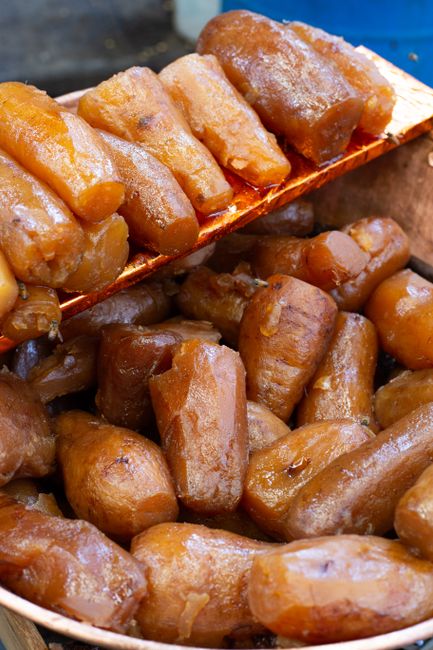
Camote is the Spanish-language name for sweet potato (Ipomoea batatas), used across Latin American, Filipino, and Spanish cooking. It's the same species sold in US supermarkets as 'sweet potato,' but the term usually points to varieties with drier, less sweet flesh and thinner, often purple or red skin rather than the moist orange-fleshed types common in North American baking. Camote is unrelated to true yams (Dioscorea), a starchier, drier tuber from a different plant family entirely, despite the two names sometimes being used interchangeably at grocery stores.
Varieties
Filipino camote typically has thin purple or red skin and pale yellow to white flesh that's drier and less sweet than the orange-fleshed sweet potatoes common in the US. Mexican camote often has yellow flesh and a milder sweetness. Okinawan purple sweet potato, sometimes also called camote, has vivid purple flesh and a starchier, less sweet profile than either. All are the same species but behave differently in cooking, particularly in how much they soften and how sweet they taste once cooked.
Buying tips
Choose firm tubers with taut, unwrinkled skin and no soft spots, sprouted eyes, or cut damage. Size doesn't affect flavor, but smaller, evenly shaped ones cook more uniformly whether boiled or roasted.
Substitutes
Orange-fleshed sweet potato (Beauregard or garnet) — 1:1
Sweeter and moister than camote, so dishes come out slightly softer and more orange in color, but cooks the same way.
Japanese sweet potato (satsumaimo) — 1:1
Similar dry, dense texture to camote and a comparable mild sweetness; a close match for frying or roasting.
Purple sweet potato (Okinawan or ube) — 1:1
More starchy and less sweet, with a striking purple color that will tint the whole dish.
Yuca (cassava) — 1:1 by weight
Starchier and not sweet at all, but works in place of camote for frying or in savory stews where texture matters more than sweetness.
Butternut squash — 3:4 by weight
Cooks faster and is sweeter with less starch; reduce liquid slightly in mashes or purees since squash releases more moisture.
Storage
Keep camote in a cool, dark, well-ventilated spot like a pantry basket, not the refrigerator, since cold temperatures turn the starch to sugar unevenly and can give the center a hard, unpleasant texture. Stored this way, unwashed and dry, camote keeps for three to four weeks. Once cut, wrap tightly and refrigerate for up to three days.
How to use
Boiled and mashed, roasted whole, or cut into wedges and deep-fried for camote cue (skewered and coated in caramelized brown sugar) or camote chips. Common in savory stews like Filipino sinigang and Latin American sancocho, where it's added toward the end of cooking since it turns mushy if simmered too long. Also boiled and blended into desserts like camote con leche or used as a filling in empanadas and turon.
What it pairs with
Works well with coconut milk, brown sugar, and cinnamon in desserts, and with pork, chorizo, garlic, and beans in savory Latin American stews. In Filipino cooking, pairs naturally with vinegar-based dishes and salty, savory proteins like tocino or longganisa.
Nutrition
A good source of vitamin A precursors (beta-carotene, especially in orange-fleshed types), vitamin C, and fiber, with a similar calorie count to a regular potato. Camote leaves, also eaten as a vegetable in Filipino cooking, are high in vitamin A and iron.
FAQ
Is camote the same as a yam?
No. Camote is a sweet potato (Ipomoea batatas); true yams belong to the genus Dioscorea, a different plant family with rougher, bark-like skin and drier, starchier flesh. US grocery stores frequently mislabel orange sweet potatoes as yams, which adds to the confusion.
Why is camote less sweet than the sweet potatoes sold in the US?
It's a matter of variety, not ripeness. Camote varieties common in the Philippines and Latin America tend to have lower sugar content and drier flesh than the orange-fleshed cultivars like Beauregard bred for US markets.
Can you eat the leaves of the camote plant?
Yes. Camote tops (talbos ng kamote) are a common vegetable in Filipino cooking, sauteed with garlic similarly to spinach or eaten in soups like tinola.
How do you tell when camote is done cooking?
A thin knife or skewer should slide into the thickest part with no resistance. Boiled camote usually takes 20 to 30 minutes depending on size; roasted whole at 400°F (200°C) takes 45 to 60 minutes.
Have camote on hand? Find recipes with our Recipe Generator →