
Caquis
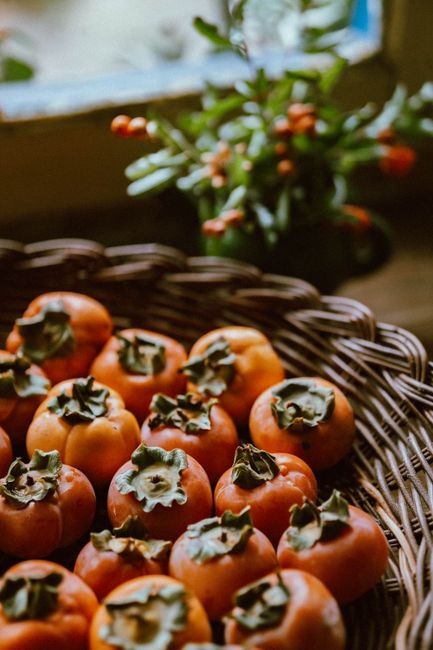
Caquis is the Spanish and Catalan name for persimmons (Diospyros kaki), a fruit that looks like a cross between a tomato and an orange, with smooth, thin skin and a flat, four-lobed calyx (the papery green cap) at the top. There are two broad categories that behave completely differently in the kitchen: astringent varieties like Hachiya, which are inedibly bitter until they turn almost jelly-soft, and non-astringent varieties like Fuyu, which can be eaten firm and crunchy like an apple. Spain's most common commercial variety, sold under the brand name Persimon, is Rojo Brillante that has been treated with a brief carbon dioxide process to remove astringency while it's still firm, so it eats like a crisp apple rather than a soft custard.
Varieties
Hachiya is the classic acorn-shaped, astringent type that must be fully soft before eating or it will taste unpleasantly bitter and chalky. Fuyu is squat and tomato-shaped, non-astringent, and can be eaten firm like an apple. Persimon (Rojo Brillante), Spain's dominant export variety, is naturally astringent on the tree but is treated after harvest with a controlled CO2 process so it can be sold and eaten firm, giving it a crisp, sweet bite unlike traditional Hachiya.
Buying tips
For firm-eating varieties, choose fruit that's glossy, deep orange, and firm with no soft spots, similar to picking a good tomato. For soft-eating varieties like Hachiya, buy them while still firm and plan to let them ripen at home over one to two weeks rather than looking for ripe ones at the store, since fully soft persimmons bruise and split easily in transit.
Substitutes
Ripe mango — 1:1 by volume
Closest match for soft, astringent-type caquis in smoothies, purees, or baked goods; similarly sweet with a comparable fiber texture once blended.
Ripe Bosc or Anjou pear — 1:1 by weight
Best stand-in for firm, non-astringent caquis (Fuyu or Persimon) in salads or sliced raw, though pears are less sweet and more tart.
Ripe apricots — 1:1 by volume, pureed
Works in baking recipes calling for persimmon pulp; slightly more acidic, so add a pinch more sugar.
Cantaloupe, diced — 1:1 by volume
Reasonable substitute for firm caquis in fruit salads for color and juiciness, though the flavor is milder and less honeyed.
Storage
Astringent caquis (Hachiya-type) need to ripen at room temperature until the skin is nearly translucent and the fruit feels like a water balloon; this can take one to three weeks. Speed it up by sealing them in a paper bag with a banana or apple. Firm, non-astringent caquis (Fuyu, Persimon) can be kept at room temperature for about a week or refrigerated for up to three weeks since they don't need to soften before eating. Once fully ripe and soft, refrigerate and use within two to three days, or scoop out the pulp and freeze it in an airtight container for up to six months.
How to use
Eat firm varieties sliced raw like an apple, in salads with arugula and goat cheese, or diced into salsas. Use fully ripened, soft varieties as a spreadable pulp in quick breads, puddings, and smoothies, or spoon them straight out of the skin with a spoon. In Japan, whole Hachiya persimmons are peeled and air-dried into hoshigaki, a chewy, sugar-dusted dried fruit.
What it pairs with
Pairs well with blue cheese, goat cheese, toasted walnuts or pecans, pomegranate seeds, and prosciutto in salads. In desserts, it complements cinnamon, nutmeg, brown sugar, and vanilla. A squeeze of lime brightens its honeyed sweetness.
Nutrition
Caquis are a good source of vitamin A, vitamin C, and dietary fiber, and one medium fruit runs around 70-120 calories depending on size and variety. The fiber content is notably high for a fruit this sweet, which is part of why unripe astringent varieties feel so drying and chalky in the mouth.
FAQ
Why did my caqui taste bitter and chalky?
It was likely an astringent variety like Hachiya eaten before it fully ripened. These varieties contain high levels of soluble tannins that only break down once the fruit turns very soft; eating one while still firm causes an intensely dry, puckering sensation.
Can you eat the skin of a caqui?
Yes, the skin is edible on both astringent and non-astringent varieties once ripe, though many people peel soft, jelly-textured Hachiya persimmons since the skin can be tough to eat with a spoon.
How do you know when a persimmon is ripe enough to eat?
For astringent types, the fruit should feel like a filled water balloon with almost no firmness left and the skin should look slightly wrinkled and translucent. Non-astringent types are ready whenever they're firm, glossy, and fully colored, similar to judging a ripe tomato.
Are caquis and kaki the same fruit?
Yes, kaki is another common name for the same species (Diospyros kaki), used widely in Japan, Korea, and parts of Europe, while caqui is the Spanish and Portuguese name.
Have caquis on hand? Find recipes with our Recipe Generator →