
Croissants
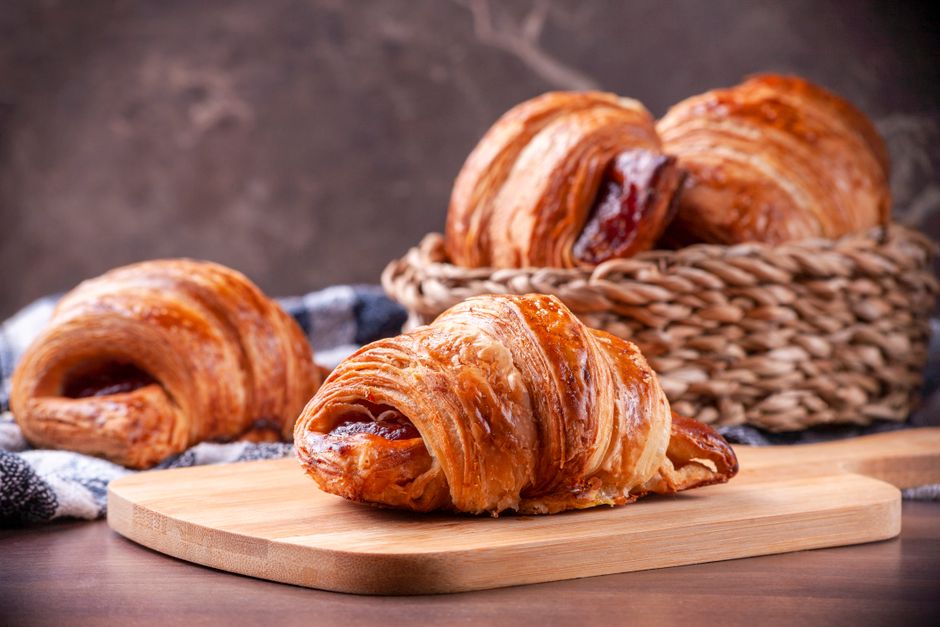
A croissant is a laminated, yeasted pastry made by folding butter into dough dozens of times to create hundreds of thin layers, then rolling and shaping it into a crescent before baking. The lamination is what gives a good croissant its shattering, flaky crust and airy, honeycombed interior, distinct from a simple bread roll or biscuit. Despite the French name, the shape originated with the Austrian kipferl; the layered butter technique was developed in France in the 19th century.
Varieties
A plain butter croissant is the base form. Pain au chocolat uses the same dough rolled around dark chocolate batons instead of curved into a crescent. Almond croissants are usually day-old croissants soaked in syrup, filled with almond cream, and rebaked. Ordinary crescent rolls sold in tubes are a different, unlaminated product and shouldn't be confused with true butter croissants.
Buying tips
Pick up a croissant and check the weight: a good one feels light and almost hollow, not dense. The layers should be visible on the cut ends in a tight spiral, and the surface should be deep golden brown, not pale. Avoid any that feel greasy to the touch, which usually means underbaked layers that didn't render the butter properly.
Substitutes
Puff pastry — 1:1 by weight
Also laminated with butter, so it browns and flakes similarly, but has no yeast, so it won't have the same open, chewy crumb. Works well in savory fillings or baked casseroles.
Brioche bread or rolls — 1:1 by weight
Softer and denser than croissant, without the flaky layers, but its buttery, slightly sweet crumb makes it a close stand-in for bread pudding or French toast.
Crescent roll dough (canned, like Pillsbury) — 1:1 by weight
Much less butter and far fewer layers, so the result is softer and less flaky, but it's the closest quick supermarket substitute for shape and mild sweetness.
Danish pastry — 1:1 by weight
Similarly laminated and buttery, sometimes already filled with fruit or cream cheese, which can add unwanted sweetness to savory recipes.
Day-old challah or egg bread — 1:1 by weight
No lamination at all, so texture is plain and soft, but its rich egg dough absorbs custard well, making it a reasonable stand-in specifically for bread pudding.
Storage
Fresh croissants are best eaten within a few hours of baking. Store leftovers at room temperature in a loosely closed paper bag for up to 2 days; a sealed plastic bag traps moisture and turns the crust soft. For longer storage, freeze in a zip-top bag for up to 2 months and refresh in a 300°F oven for 8-10 minutes to re-crisp the layers.
How to use
Split and fill for breakfast sandwiches with eggs and cheese, slice for ham-and-cheese or turkey sandwiches, cube slightly stale ones for croissant bread pudding or French toast bake, or split and toast with butter and jam. Day-old croissants that have gone slightly stale actually work better than fresh ones for bread pudding since they absorb custard without turning to mush.
What it pairs with
Pairs naturally with strong coffee or espresso, fruit preserves, dark chocolate, and soft cheeses like brie. For savory versions, ham, gruyere, and Dijon mustard are classic fillings.
Nutrition
Croissants are high in saturated fat and refined carbohydrates due to the layered butter and enriched dough; a standard bakery croissant runs roughly 230-280 calories, most of it from butter. They offer little fiber or protein on their own.
FAQ
Why do some croissants taste doughy or heavy?
That usually means the butter wasn't properly laminated into thin, even layers, or the dough was underproofed before baking, both of which collapse the airy structure into something denser and chewier.
Can you freeze unbaked croissant dough?
Yes. Shape the croissants first, freeze them uncovered on a tray until solid, then transfer to a bag. Thaw and proof them in the refrigerator overnight before baking straight from cold.
What's the difference between a croissant and a crescent roll?
A true croissant uses laminated yeasted dough folded with butter dozens of times, producing distinct flaky layers. Canned crescent rolls use a simpler, less-laminated dough with far less butter, so they're softer and less flaky.
Are all croissants made with butter?
Traditional French croissants must use butter by law under certain bakery labeling standards; margarine-based versions exist but lack the same flavor and don't laminate as cleanly since margarine has a different melting point.
Have croissants on hand? Find recipes with our Recipe Generator →