
Fernet
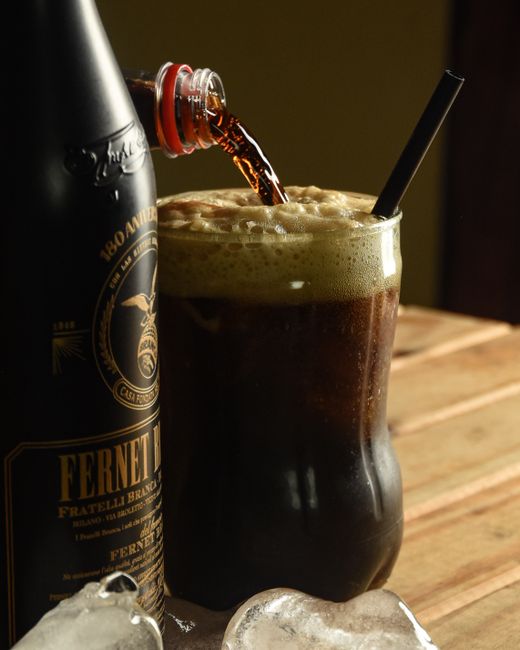
Fernet is a bitter, herbal Italian liqueur (amaro) made from a base of grape spirit infused with a proprietary blend of roots, herbs, and spices, commonly including saffron, myrrh, chamomile, and cardamom, then aged in oak casks. It's intensely bitter, medicinal, and aromatic, with an alcohol content typically between 39% and 45% ABV. Fernet-Branca, made in Milan since 1845, is the dominant brand and the one most bars stock, but other producers make their own versions with different herb blends.
Varieties
Fernet-Branca is the most widely distributed and the recipe most people mean by 'fernet,' but Italian and Argentine producers make their own versions with distinct herb blends, ranging from more menthol-forward (common in versions popular in Argentina) to more bitter and medicinal (closer to traditional Italian styles). Argentina is actually the largest consumer market for fernet by volume, and some bottles are blended specifically for that market with a smoother, slightly sweeter profile.
Buying tips
Fernet-Branca is the standard reference point and the easiest to find; if a recipe just says 'fernet' without specifying, it means Fernet-Branca. Smaller or regional brands (Fernet Vittone, Fernet Branca's competitors like Cinzano or Luxardo's amaro line) vary in sweetness and menthol intensity, so taste before substituting in a recipe that depends on a specific balance. A standard 750ml bottle lasts a long time given how little is used per drink.
Substitutes
Amaro Nonino or another lighter amaro — 1:1
Milder and sweeter than fernet, with less menthol and bitterness; works in cocktails calling for fernet as a modifier but won't replicate its sharp medicinal edge.
Underberg (concentrated digestif bitters) — 1 part Underberg diluted with 2 parts water or spirit
Much more concentrated and less sweet than fernet, so it needs dilution to avoid overwhelming a drink; closest in bitterness intensity.
Angostura bitters mixed with a neutral spirit — 1 part Angostura to 4 parts vodka or grain spirit
A rough approximation for cocktails; captures the bitter, spiced character but lacks fernet's minty, resinous depth.
Jägermeister — 1:1 by volume, adjusted to taste
Sweeter and less bitter than fernet, with a stronger anise-clove flavor; a reasonable stand-in in a Fernet and Cola but changes the character noticeably.
Non-alcoholic amaro alternative (such as a bittersweet herbal aperitif) — 1:1
For alcohol-free drinks; these products are formulated to mimic amaro's bitterness and herbal complexity without the proof.
Storage
Store an opened bottle upright in a cool, dark place away from direct sunlight; a liquor cabinet or pantry shelf works fine. Because of its high alcohol content, fernet doesn't need refrigeration and doesn't spoil, though its aromatic intensity can fade slowly over a year or two once opened. Keep the cap tightly sealed to limit oxidation.
How to use
Sipped as a digestif after a heavy meal, often neat or over ice. Mixed with cola (the classic Fernet and Coke, popular in Argentina), or with ginger ale or soda water to cut the bitterness. Used in small quantities, often just a few drops or a barspoon, as a bitters substitute to add complexity to cocktails like a Hanky Panky or a fernet-spiked Manhattan. Some bartenders use a rinse of fernet in a chilled glass before building a cocktail rather than mixing it in directly.
What it pairs with
Pairs well with cola, ginger beer, and espresso for contrast against its bitterness. In food, a small amount stirred into chocolate desserts or brushed onto grilled meats echoes the way amari are used in Italian cooking to cut richness. Complements coffee-based cocktails and after-dinner settings alongside dark chocolate.
Nutrition
Fernet is consumed in small pours, typically 1 to 2 ounces, and contributes calories mainly from alcohol, roughly 90 to 100 calories per 1.5-ounce serving, with negligible sugar in most versions since it's formulated to be bitter rather than sweet.
FAQ
Why does fernet taste so different from other liqueurs?
Its flavor comes from a dense blend of dozens of roots, barks, and herbs, including saffron and myrrh in Fernet-Branca's recipe, aged in oak, which produces a bitter, minty, medicinal taste unlike sweeter amari or liqueurs.
Is fernet the same as an amaro?
Fernet is a specific style within the broader amaro category. All fernets are amari, but not all amari are fernets; amaro is the umbrella term for Italian bitter herbal liqueurs, and fernet refers to the more intensely bitter, menthol-heavy subtype.
Can fernet go bad after opening?
No, its high alcohol content preserves it indefinitely once opened. The main change over time is a gradual softening of aroma, not spoilage, so an old bottle is safe but may taste slightly less vibrant.
What's the standard way to drink fernet if it's too bitter straight?
Mix roughly 1 part fernet to 2 or 3 parts cola over ice, the standard Fernet and Coke ratio used throughout Argentina, which balances the bitterness with sweetness and carbonation.
Have fernet on hand? Find recipes with our Recipe Generator →