
Gobi Manchurian
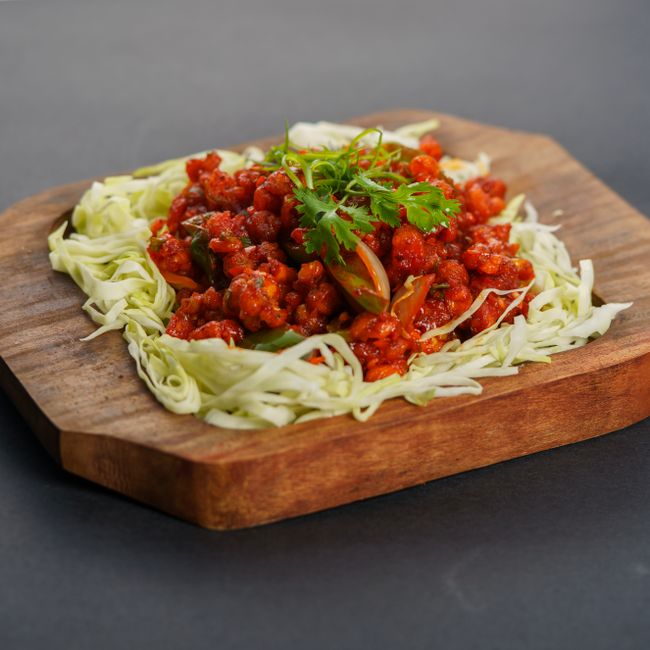
Gobi Manchurian is an Indo-Chinese dish of battered, deep-fried cauliflower florets (gobi means cauliflower in Hindi) tossed in a sweet-savory-spicy sauce built from garlic, ginger, soy sauce, vinegar, and ketchup or chili sauce. It originated in Mumbai's Chinese immigrant community and is now a staple street food and restaurant appetizer across India, served either dry (as a starter, sauce clinging tightly) or gravy-style (with extra sauce, eaten with fried rice or noodles).
Varieties
Dry Gobi Manchurian uses just enough sauce to coat the fried florets and is eaten as a stand-alone appetizer, while gravy Manchurian includes a cornstarch-thickened sauce with extra stock or water, meant to be spooned over rice or noodles rather than eaten on its own.
Buying tips
Choose a cauliflower head that's compact and creamy white with tightly closed florets and no brown spots or a strong sulfur smell; loose, spreading florets fry unevenly and absorb more oil.
Substitutes
Cauliflower florets, par-boiled and dried well — 1:1
The standard base. Par-boiling for 2-3 minutes before battering keeps the inside tender while the coating stays crisp; drying thoroughly prevents oil from spattering and keeps the batter from going soggy.
Broccoli florets — 1:1
Holds its shape well when fried and takes the sauce just as readily, though the flavor is slightly more vegetal and less neutral than cauliflower.
Paneer cubes — 1:1
Turns the dish into 'paneer Manchurian'; skip the par-boiling step and pat the paneer dry before battering so the coating adheres.
Button mushrooms, halved — 1:1
Needs no par-boiling since mushrooms cook through quickly in the fryer, but they release moisture, so batter them just before frying, not ahead of time.
Baby corn, halved lengthwise — 1:1
A common street-food variant with a firmer, slightly sweet bite; par-boil briefly if using raw baby corn rather than canned.
Storage
Fried gobi keeps separately from the sauce best. Store cooked florets and prepared sauce in separate airtight containers in the refrigerator for up to 2 days, and toss them together only when reheating to eat, since pre-tossed gobi turns soggy overnight. Reheat the florets in a hot oven or air fryer, not the microwave, to bring back crispness before saucing.
How to use
Serve dry-style as an appetizer or party snack with toothpicks, or gravy-style spooned over fried rice, hakka noodles, or plain steamed rice. It also works folded into a wrap with shredded cabbage and mayo for an Indo-Chinese roll.
What it pairs with
Pairs naturally with vegetable fried rice, hakka noodles, or a simple cucumber-onion salad to cut the richness. A cold beer or a sweet lassi balances the chili heat well.
Nutrition
Deep-frying and a sugar-forward sauce make this a higher-calorie, higher-sodium dish despite the vegetable base; cauliflower itself contributes vitamin C and fiber, most of which survives frying reasonably well since the florets aren't cooked to mush.
FAQ
Why does my gobi Manchurian turn soggy after frying?
Usually because the cauliflower wasn't dried thoroughly after par-boiling, or the fried florets sat too long before being tossed in sauce. Toss just before serving, not ahead of time.
What gives gobi Manchurian its dark red-brown color?
A combination of soy sauce, ketchup or tomato-chili sauce, and sometimes a small amount of red chili paste; some restaurant versions add red food coloring, which home versions don't need.
Can gobi Manchurian be made without deep-frying?
Yes, baking or air-frying the battered florets at high heat gets close to the same crisp texture with less oil, though the coating will be slightly less crunchy than deep-fried.
Is gobi Manchurian very spicy?
Base recipes are only mildly spicy from green chilies and a touch of chili sauce; heat level is easy to adjust up or down since the chili components are added separately from the soy-vinegar-ketchup base.
Have gobi manchurian on hand? Find recipes with our Recipe Generator →