
Green Mango
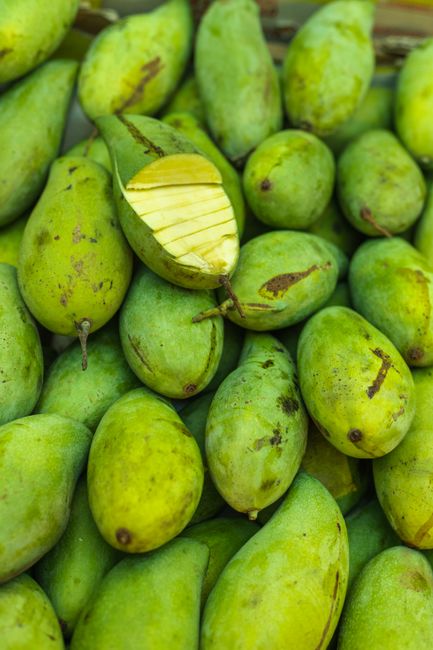
Green mango is simply mango picked and eaten before it ripens, while the flesh is still firm, starchy, and sour rather than sweet and soft. It's not a separate variety, any mango cultivar can be used green, though certain varieties (like Thai Nam Dok Mai or Indian Totapuri) are grown specifically to be harvested and sold unripe. The flesh stays crisp like a raw potato or unripe pear and carries a sharp, citrus-like tartness instead of tropical sweetness.
Varieties
Any mango variety can be eaten green, but some, like Thai Nam Dok Mai and Indian Totapuri or Rajapuri, are specifically favored for their firm texture and pronounced sourness when unripe, while soft, fiber-heavy varieties like Alphonso are rarely used green since they don't hold a clean julienne.
Buying tips
Choose mangoes that are uniformly hard with no give when pressed and skin that's fully green with no yellow or red blush starting to show. A faint sweet smell at the stem end means ripening has already begun and the fruit will be less sour and less crisp.
Substitutes
Green (unripe) papaya, shredded — 1:1 by volume
Similar crunchy texture and mild tartness once dressed with lime and chili; slightly less acidic on its own so add extra lime juice.
Granny Smith apple, julienned, tossed with lime juice — 1:1 by volume
Closest supermarket stand-in for salads; toss with lime juice immediately to prevent browning and to boost sourness closer to green mango.
Tamarind pulp diluted with water — start with 1 tablespoon per cup of dish
Contributes the sour flavor note but none of the crunch, useful only when green mango is functioning as a souring agent in a curry or chutney rather than a textural ingredient.
Amchur (dried green mango powder) — 1/2 teaspoon per cup of raw green mango called for
A pantry stand-in for sourness in cooked dishes like dals and marinades; adds no texture and works only where green mango was already being cooked down.
Storage
Whole green mangoes keep at room temperature for up to two weeks since they aren't ripening in the usual sense if picked hard and green; refrigerate once cut, wrapped tightly, and use within 3-4 days as the cut flesh browns and softens. Shredded or julienned green mango for salads is best used the same day.
How to use
Shredded or julienned raw into Thai and Vietnamese salads with fish sauce, lime, and chili; grated into Indian chutneys and pickles (achaar); simmered into South and Southeast Asian curries and dals as a souring agent; sliced thin and eaten plain with salt, chili powder, and a squeeze of lime as a street snack.
What it pairs with
Pairs naturally with fish sauce, lime, chili, and toasted peanuts in Southeast Asian salads, and with mustard oil, fenugreek, and asafoetida in Indian pickles and chutneys. Also good alongside grilled shrimp or pork where its acidity cuts through fat.
Nutrition
Green mango is lower in sugar than ripe mango since the starches haven't converted yet, and it's notably high in vitamin C, often more than the ripe fruit. It's commonly eaten with salt or chili which adds sodium not reflected in the raw fruit's own nutrition.
FAQ
Is green mango just an unripe version of the same fruit sold ripe?
Yes, it's the identical fruit harvested earlier; the flesh converts starch to sugar and softens as it ripens, so green mango is simply caught before that process happens.
Can green mango ripen on the counter like a regular mango?
Yes, if left at room temperature it will gradually soften and sweeten over several days to a week, though very hard, immature fruit picked too early may never ripen properly and stays fibrous.
Why does green mango turn brown quickly once cut?
Its high concentration of enzymes and vitamin C reacts fast with air; tossing cut pieces immediately in lime or lemon juice slows the browning noticeably.
Is green mango safe to eat raw?
Yes, it's commonly eaten raw in salads and snacks across South and Southeast Asia; its high acidity is what makes it taste sour rather than any safety issue.
Have green mango on hand? Find recipes with our Recipe Generator →