
Japanese Desserts
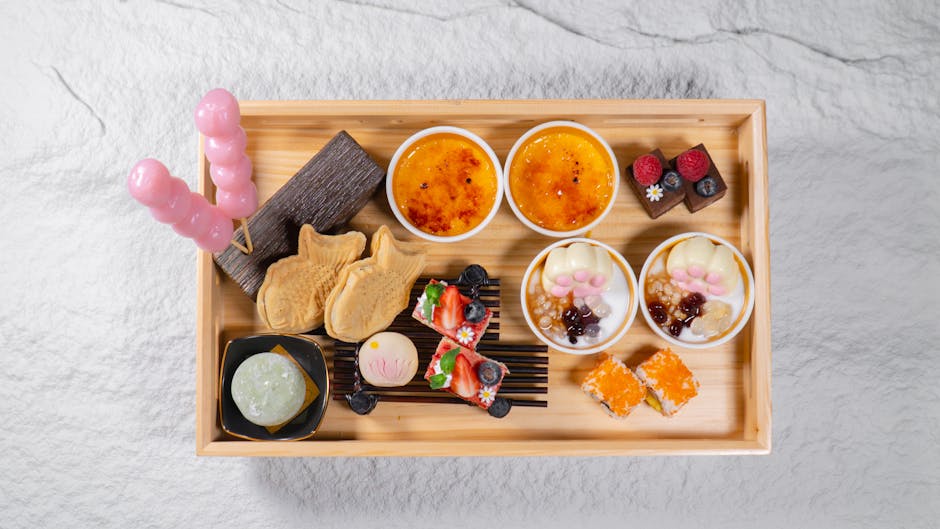
Japanese desserts split broadly into wagashi, the traditional confections built from rice, beans, and agar, and yogashi, Western-style sweets adapted after the late 1800s (cheesecakes, choux pastries, shortcakes). Wagashi rely on a small set of core ingredients used in different ratios and shapes: glutinous rice flour (mochiko or shiratamako) for mochi and dango, sweetened red or white bean paste (anko) as filling, kanten (agar-agar) for jellied sweets like mizu yokan, and matcha or kinako (roasted soybean flour) for flavoring and coating. Sweetness is kept lower than in most Western desserts because these are eaten alongside bitter green tea.
Varieties
Wagashi are further divided by moisture content: namagashi are fresh, high-moisture sweets (mochi, dango, nerikiri) meant to be eaten within a day or two, while higashi are dry, pressed sweets (rakugan) that keep for weeks and are often shaped into small molded designs. Yogashi is a separate category entirely, referring to Western-influenced baked goods like Japanese-style strawberry shortcake or castella sponge cake, which use butter, eggs, and wheat flour in ways traditional wagashi does not.
Buying tips
Mochiko, shiratamako, anko, and kanten are all sold shelf-stable at Japanese and Asian grocery stores, and increasingly in the international aisle of larger supermarkets. Buy matcha labeled specifically for culinary or baking use rather than ceremonial grade, since ceremonial matcha is priced for drinking straight and its subtler flavor gets lost once mixed into batter.
Substitutes
Sweetened black bean paste for anko (red bean paste) — 1:1
Nearly identical texture and sweetness level; swap directly in mochi, dorayaki, or taiyaki filling.
Canned sweetened white bean paste (shiro-an) for red anko — 1:1
Milder, less earthy flavor and a lighter color; works well in wagashi where a pale filling is wanted.
Glutinous rice flour (mochiko) for shiratamako — 1:1 by weight, add slightly less water
Shiratamako gives a smoother, more elastic dough; mochiko is coarser and needs a bit less liquid to reach the same consistency.
Tapioca starch plus rice flour for mochiko (gluten-free, allergy workaround) — 3 parts rice flour to 1 part tapioca starch, replacing 1 part mochiko
Produces a chewier, slightly less stretchy mochi; best for dango and manju rather than fine mochi skins.
Unflavored gelatin for kanten (agar) — Use about half the amount of gelatin by weight, dissolved per package directions
Gelatin sets softer and melts at room temperature, unlike agar; not suitable if the dessert needs to hold shape unrefrigerated, but works for chilled jellies like mizu yokan.
Sweetened cocoa powder for matcha (color and flavor stand-in only) — 1:1 in baked batters, not in traditional wagashi
Changes the flavor completely and loses the bitterness matcha is meant to balance against sugar; use only when matcha is unavailable and a green color isn't required.
Storage
Fresh mochi and dango dry out and stiffen within hours at room temperature and turn gummy or hard if refrigerated, since the starch retrogrades in the cold; keep them tightly wrapped at room temperature and eat within a day, or freeze for longer storage and thaw briefly before serving. Anko keeps refrigerated in an airtight container for about a week or frozen for a few months. Kanten-based jellies like mizu yokan hold up well refrigerated for several days since agar doesn't weep the way gelatin can.
How to use
Wagashi are traditionally served alongside matcha or hojicha during tea ceremonies and seasonal celebrations (sakura mochi in spring, tsukimi dango at the autumn moon-viewing festival, New Year's mochi). Dorayaki and taiyaki are common street-food and snack items filled with anko, custard, or chocolate. Kanten desserts are typically served chilled as a light, low-fat finish to a meal.
What it pairs with
Nearly all wagashi are designed to be eaten with unsweetened green tea, particularly matcha or hojicha, whose bitterness offsets the dessert's sugar. Kinako-dusted mochi pairs well with roasted teas, and citrus-forward wagashi like yuzu-flavored jellies pair well with lighter sencha.
Nutrition
Wagashi are generally lower in fat than Western desserts since they rely on rice, beans, and agar rather than butter or cream, but they can be high in added sugar. Mochi and dango made from rice flour are naturally gluten-free; check that anko and any coatings haven't been cross-processed if this matters.
FAQ
What's the difference between mochi and dango?
Mochi is made from pounded glutinous rice (or mochiko dough) and has a stretchier, softer texture; dango is made from a firmer rice flour dough, rolled into balls, and often skewered, giving it a denser, slightly springier bite.
Is anko always made from red beans?
No. Traditional anko uses adzuki beans, but shiro-an (white bean paste, usually from lima or navy beans) and ogura-an (chunky, less-mashed adzuki) are both common variations with different textures and sweetness.
Why does homemade mochi go hard so quickly?
Mochi's rice starch retrogrades (recrystallizes) rapidly at room temperature and even faster when refrigerated, which stiffens the texture within hours; commercial mochi stays soft longer because it often includes trehalose or other starches that slow this process.
Are Japanese desserts less sweet than Western desserts?
Generally yes. Wagashi are formulated to be eaten with bitter, unsweetened green tea, so their sugar content is typically lower than comparable Western pastries or cakes eaten on their own.
Have japanese desserts on hand? Find recipes with our Recipe Generator →