
Spatchcock Chicken
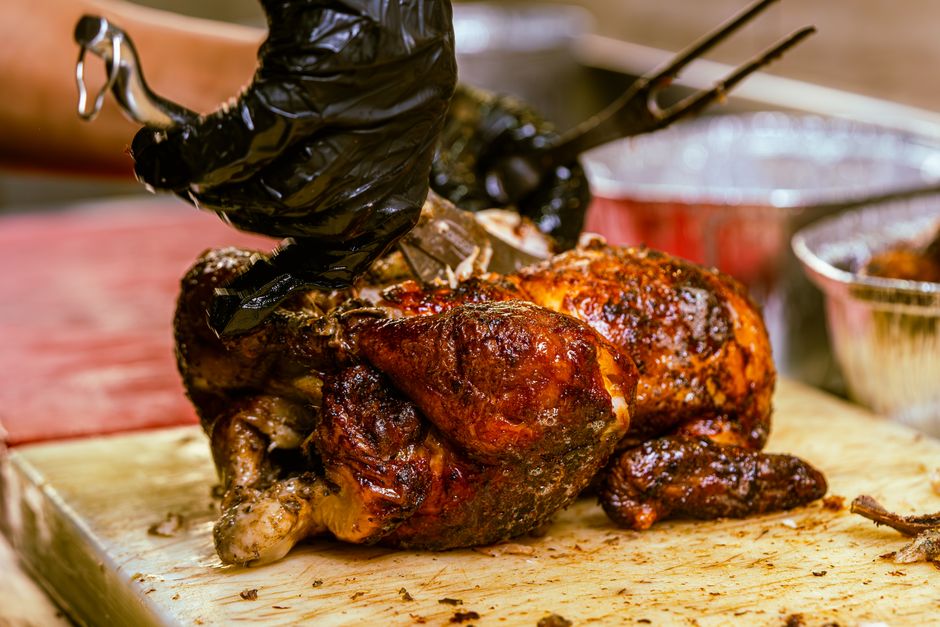
Spatchcocking is the technique of cutting out a whole chicken's backbone with shears or a sharp knife, then pressing the bird flat so it cooks in one even layer. It's also called butterflying. The flattened shape exposes more skin to heat, so the skin crisps more evenly and the whole chicken roasts in roughly two-thirds the time of a trussed, upright bird, with white and dark meat finishing closer to the same time.
Varieties
Spatchcocking and butterflying refer to the same technique on a whole chicken. 'Spatchcock' is used almost exclusively for poultry, while 'butterfly' is also used for cutting open thinner cuts like chicken breasts or pork chops to open them flat, which is a different cut and doesn't involve removing a backbone.
Buying tips
A 4-5 pound whole chicken spatchcocks most easily and roasts through in about an hour. Some butcher counters and grocery stores sell chickens already spatchcocked, usually labeled 'butterflied,' which saves the step of cutting out the backbone yourself. Kitchen shears designed for poultry make the cut far easier than a knife.
Substitutes
Whole chicken, roasted upright (not spatchcocked) — n/a
Works with the same bird and seasonings but takes 25-40 minutes longer and the skin on the thighs and back won't crisp as evenly.
Chicken halves (split through the breastbone and backbone) — n/a
A butcher can split a whole chicken into two halves; they cook almost as fast as a spatchcocked bird and are easier to serve as two portions.
Bone-in, skin-on chicken parts (leg quarters and split breasts) — n/a
Skip the backbone removal entirely and roast pieces on a sheet pan; cook times run 35-45 minutes at 425°F depending on piece size.
Spiral or beer-can method (upright on a stand) — n/a
Produces very moist meat and self-bastes as it roasts, but the skin stays soft on the parts touching the stand and cook time is longer than spatchcocking.
Storage
Raw spatchcocked chicken keeps in the refrigerator, covered, for 1-2 days, the same as any raw whole chicken. Once cooked, refrigerate in an airtight container for 3-4 days, or portion and freeze for up to 4 months. Because the flattened shape has more surface area, cooked leftovers dry out faster than a whole roasted bird, so reheat gently with a splash of broth.
How to use
Best for high-heat roasting (425-450°F), grilling over indirect heat, and air frying, since the flat shape lets heat reach the meat and skin evenly on all sides. It also fits better under a broiler and on a standard sheet pan than a whole trussed chicken. Once cooked, carve it the same way as any roast chicken: legs, thighs, wings, then slice the breast across the flattened breastbone.
What it pairs with
Rub with olive oil, salt, and black pepper before roasting, or add garlic, lemon zest, and rosemary or thyme under the skin. The flat shape works well roasted directly over a bed of vegetables like potatoes, carrots, or Brussels sprouts, which catch the rendered fat and pan drippings.
Nutrition
Spatchcocking doesn't change the chicken's nutrition, only its shape and cook time. A skin-on serving runs higher in fat than skinless; removing the skin after cooking cuts calories and fat significantly while keeping the protein.
FAQ
What does spatchcock actually mean?
It means removing the backbone from a whole bird and flattening it, so the chicken lies flat with the breastbone facing up. The term is thought to come from an old Irish phrase for a quickly prepared, split and grilled bird.
Do you need special tools to spatchcock a chicken?
Poultry shears make the cut fastest and cleanest, but a sharp chef's knife works too. After cutting out the backbone, you press down firmly on the breastbone to crack it and flatten the bird.
How much faster does a spatchcocked chicken cook?
A 4-5 pound spatchcocked chicken typically roasts in 45-55 minutes at 425°F, compared to about 75-90 minutes for the same size bird roasted whole and upright.
Can you spatchcock a turkey the same way?
Yes, the technique is identical, and it's especially useful for turkey since it cuts roasting time roughly in half and helps the breast and legs finish closer to the same time.
What do you do with the backbone you remove?
Freeze it along with wing tips and other trimmings to use later for chicken stock; it doesn't need to be discarded.
Have spatchcock chicken on hand? Find recipes with our Recipe Generator →