Gluten-Free Pita Bread Recipe
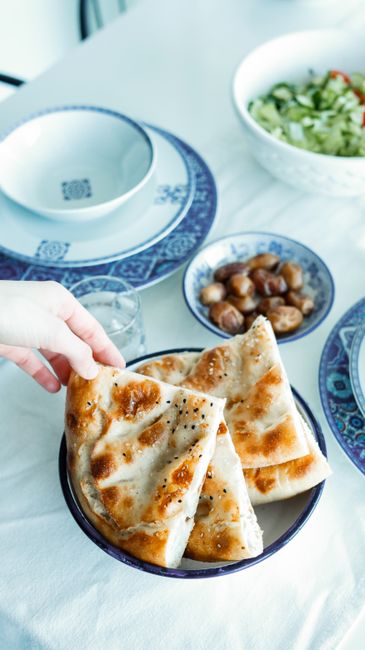
Psyllium husk powder acts as the gluten substitute here, binding the dough enough to trap steam, while a very hot stone or skillet flashes that steam into a pocket before the crust has a chance to set and block it.
- Prep
- 1 hr 30 min
- Cook
- 15 min
- Total
- 1 hr 45 min
- Servings
- 6
Ingredients
- 2 cups gluten-free all-purpose flour blend (with xanthan gum)
- 2 tbsp psyllium husk powder
- 2 1/4 tsp instant yeast
- 1 tbsp granulated sugar
- 1 tsp salt
- 1 1/4 cups warm water (about 110°F)
- 2 tbsp olive oil, plus more for brushing
- 1 large egg, room temperature
Nutrition per serving
- Calories
- 228
- Protein
- 3g
- Carbs
- 37g
- Fat
- 6g
Based on the recipe as written, one serving. Recalculates if you swap an ingredient above. An estimate only, exact values depend on the specific ingredients used.
Need different units or a different yield? Try our Conversion Calculator →
Instructions
- 1Place a pizza stone, baking steel, or heavy cast-iron skillet on the middle rack and preheat the oven to 500°F (260°C) for at least 30 minutes before baking.
- 2In a large bowl, whisk together the gluten-free flour blend, psyllium husk powder, instant yeast, sugar, and salt.
- 3Add the warm water, olive oil, and egg. Mix with a spatula or stand mixer paddle for 2-3 minutes until you get a thick, sticky, cohesive dough (it will look more like a thick batter than a kneadable bread dough, that's expected).
- 4Cover the bowl and let the dough rest at room temperature for 45-60 minutes. It won't double dramatically, but it will firm up noticeably as the psyllium absorbs the water.
- 5Divide the dough into 6 equal portions. With wet or oiled hands, pat and press each portion between two sheets of parchment or plastic wrap into a round about 6 inches wide and 1/4 inch thick.
- 6Working in batches, carefully slide one or two rounds directly onto the hot stone or skillet using the parchment as a sling. Bake for 3-4 minutes, until the pita puffs into a dome and the bottom is spotted golden brown.
- 7Remove with a spatula, brush lightly with olive oil, and stack the pitas under a clean kitchen towel while the rest cook, this keeps them soft and pliable.
Tips & variations
- Weigh the flour blend rather than scooping with a cup, gluten-free blends pack down in the bag and an overloaded cup makes for a dry, cracked dough.
- No pizza stone or steel? A cast-iron skillet preheated on the stovetop over medium-high heat, then finished in the same hot oven, works almost as well.
- For a dairy-free, egg-free version, replace the egg with 3 tablespoons of aquafaba, the pitas puff slightly less but still form a pocket.
- Add 1 teaspoon of dried oregano or za'atar to the dry ingredients for a flavored pita to serve alongside dips.
Storage & reheating
Store cooled pitas in a sealed bag at room temperature for up to 2 days, or in the refrigerator for up to 5 days. Freeze in a single layer, then bag together, for up to 2 months. Reheat directly from frozen in a dry skillet over medium heat for about a minute per side, or in a 350°F (175°C) oven for 5 minutes wrapped in foil.
Tips from the Tulo kitchen
- Rolling the dough between parchment sheets instead of on a floured counter keeps gluten-free dough, which is naturally stickier, from tearing when you transfer it to the hot stone.
- If a pita doesn't puff, it will still taste fine split open and stuffed like a flatbread, just slice a pocket in with a knife once cooled instead.
FAQ
Why didn't my gluten-free pita puff into a pocket?
The most common causes are an oven or stone that wasn't fully preheated, dough rolled unevenly thick in spots, or dough that didn't rest long enough for the psyllium to hydrate and firm up.
Can I use a different gluten-free flour blend?
Yes, but check whether it already includes xanthan gum. If it doesn't, add 1 teaspoon of xanthan gum to the dry ingredients or the dough will be too crumbly to hold together.
Is psyllium husk powder necessary, or can I skip it?
It's what replaces the stretch gluten normally provides, so skipping it results in a dense, cracker-like flatbread rather than a soft pita with a pocket. Ground flaxseed can be substituted at the same weight but gives a slightly denser result.
Can this dough be made ahead and refrigerated?
Yes. After the initial rest, refrigerate the dough tightly covered for up to 24 hours. Let it sit at room temperature for 20 minutes before dividing and rolling, since cold dough is stiffer and harder to shape evenly.