Sourdough Bagel Recipe
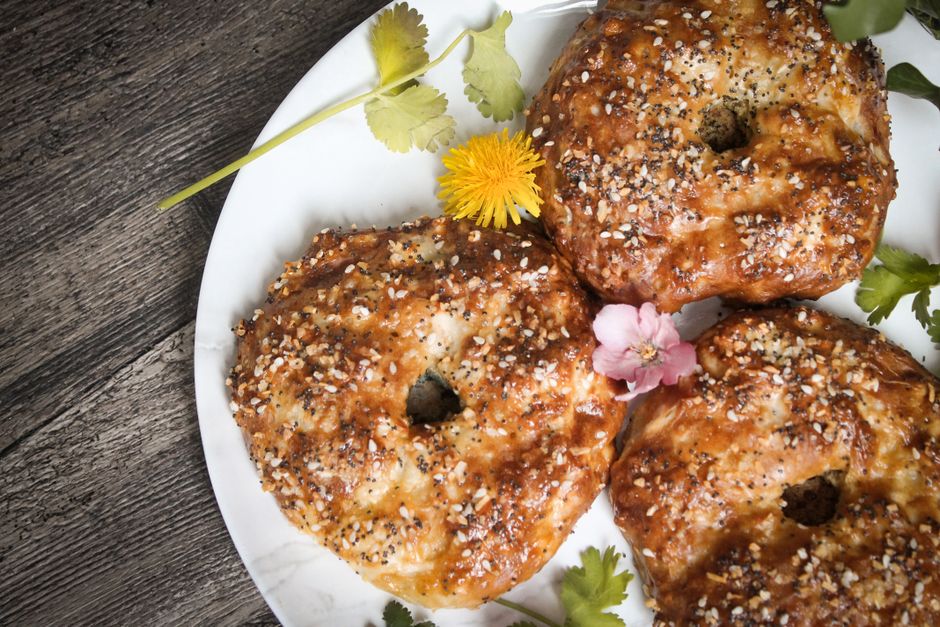
A long, cool bulk ferment and an overnight cold retard let the sourdough starter develop real tang and structure without commercial yeast, while a stiff, low-hydration dough and a baking-soda boil give the bagels their signature dense chew and shiny, deeply browned crust.
- Prep
- 45 min
- Cook
- 25 min
- Total
- 1210 min
- Servings
- 8
Ingredients
- 1 cup active sourdough starter, fed and bubbly
- 4 cups bread flour
- 1 1/4 cups water, room temperature
- 3 tbsp barley malt syrup, divided (or honey)
- 2 tsp fine sea salt
- 1 tbsp baking soda (for the boiling water)
- 3 tbsp everything bagel seasoning or sesame seeds, for topping
Nutrition per serving
- Calories
- 277
- Protein
- 9g
- Carbs
- 55g
- Fat
- 2g
Based on the recipe as written, one serving. Recalculates if you swap an ingredient above. An estimate only, exact values depend on the specific ingredients used.
Need different units or a different yield? Try our Conversion Calculator →
Instructions
- 1The night before, feed the starter and let it sit at room temperature until doubled and bubbly, with a domed top, roughly 6-8 hours.
- 2In a large bowl, combine the active starter, bread flour, water, and 1 tablespoon of the malt syrup. Mix by hand until a shaggy, stiff dough forms with no dry flour left. Cover and let rest (autolyse) for 30 minutes.
- 3Sprinkle the salt over the dough and knead by hand or in a stand mixer with a dough hook for 8-10 minutes, until the dough is smooth, stiff, and pulls cleanly away from the bowl. This dough should feel noticeably firmer than a standard sandwich bread dough.
- 4Cover the bowl and let the dough bulk ferment at room temperature for 4 to 6 hours, until visibly puffed and about 1.5 times its original size. It will not double the way a yeasted dough would.
- 5Turn the dough out and divide into 8 equal pieces (about 105g each). Shape each piece into a smooth ball, then poke a hole through the center with a floured finger and stretch it to about 2 inches wide.
- 6Place the shaped bagels on a parchment-lined sheet pan, cover loosely with plastic wrap, and refrigerate for 12 to 16 hours.
- 7The next day, preheat the oven to 425°F (220°C). Bring a wide pot of water to a boil and stir in the baking soda and the remaining 2 tablespoons of malt syrup.
- 8Working in batches of 2-3, boil the cold bagels for 60-90 seconds per side, then lift out with a slotted spoon and drain briefly on a clean towel.
- 9Transfer the boiled bagels to a parchment-lined sheet pan and immediately sprinkle with the everything bagel seasoning or sesame seeds while the surface is still tacky.
- 10Bake for 20-25 minutes, until deep golden brown all over, rotating the pan halfway through.
- 11Cool on a wire rack for at least 20 minutes before slicing; the crumb is still setting up right out of the oven.
Tips & variations
- No barley malt syrup on hand? Honey or dark brown sugar work as a substitute in both the dough and the boiling water, though the crust color will be a shade lighter.
- For a milder tang, shorten the cold retard to 8-10 hours; for a sourer bagel, push it closer to 20 hours.
- Add 1/3 cup finely chopped dried cranberries and a teaspoon of orange zest to the dough after kneading for a cinnamon-raisin-style variation.
- If the dough feels slack or sticky at any point, work in another tablespoon or two of flour, bagel dough should feel closer to Play-Doh than to a soft bread dough.
Storage & reheating
Store cooled bagels in a paper bag at room temperature for up to 2 days, or in a sealed plastic bag for up to 4 days (the crust will soften). For longer storage, slice and freeze for up to 3 months; toast frozen bagel halves directly, no need to thaw first.
Tips from the Tulo kitchen
- Weigh the flour and starter rather than measuring by volume; bagel dough is stiff enough that small hydration swings noticeably change the chew.
- If the dough springs back and resists shaping, let it rest, covered, for 10 minutes before trying again, the gluten needs time to relax.
FAQ
Can I use starter discard instead of active starter?
No. This dough relies on the starter's rising power since there's no added commercial yeast, so it needs to be fed and at or near its peak, doubled and domed, not flat discard.
Why do bagels get boiled before baking?
Boiling briefly gelatinizes the surface starch and sets the crust before the interior fully bakes, which is what gives bagels their dense, chewy bite instead of a soft, bread-like crumb.
Can I skip the overnight cold retard?
You can bake the same day after the bulk ferment, but the flavor will be much milder and the shaped bagels may spread slightly in the boiling water since the dough hasn't had time to firm up.
Can I make these with all-purpose flour instead of bread flour?
All-purpose flour will work, but the lower protein content produces a softer, less chewy bagel; bread flour's higher gluten content is a big part of what gives bagels their characteristic dense chew.