
French Martini
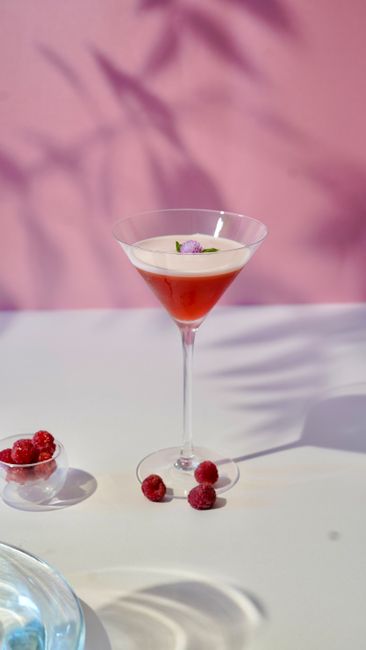
A French Martini is a shaken cocktail built from vodka, Chambord (a black raspberry liqueur from the Loire Valley), and pineapple juice, usually in roughly a 4:1:2 ratio. It has no vermouth and isn't stirred like a true martini; it's shaken hard and strained into a chilled glass, which gives it a light foam cap from the pineapple juice. It was created in the early 1980s and popularized through 1990s New York bar menus, most often credited to Keith McNally's Odeon.
Varieties
The French Martini is often confused with the Pornstar Martini, which swaps pineapple juice for passion fruit puree and adds a side shot of prosecco. It's also distinct from a Kamikaze, which uses triple sec and lime instead of Chambord and pineapple and is served on the rocks or as a shot rather than shaken and strained.
Buying tips
Buy the actual Chambord bottle (recognizable by its round, ornate glass) if the goal is the classic flavor; cheaper raspberry liqueurs are noticeably thinner and less floral. For pineapple juice, unsweetened or 100% juice versions give a cleaner, less syrupy drink than pineapple juice cocktails or blends with added sugar.
Substitutes
Crème de cassis (black currant liqueur) — 1:1
Deeper, less fruity-sweet than Chambord and slightly more tart; color turns more purple-red than pink.
Raspberry syrup or puree, reduced by a third — 3:4 (use less)
No alcohol, so the drink loses some backbone; cut the volume down or add an extra splash of vodka to compensate.
Chambord-style raspberry liqueur (Merlet, Briottet) — 1:1
Nearly identical flavor profile and sweetness; swap in directly with no other changes.
Framboise eau-de-vie plus a teaspoon of simple syrup — 1:1 plus syrup
Framboise is dry and much less sweet than Chambord, so it needs added sugar or the drink turns tart and thin.
Storage
An unopened bottle of Chambord keeps for years in a cool, dark cabinet. Once opened, refrigerate it; the sugar content keeps it from spoiling quickly, but chilling preserves the fruit flavor for up to a year. Fresh pineapple juice should be used within 3 to 4 days of opening or juicing; bottled shelf-stable juice lasts until its printed date unrefrigerated, then about a week once opened.
How to use
Shake 2 oz vodka, 0.5 oz Chambord, and 1.5 oz pineapple juice hard with ice for about 12 seconds, then double-strain into a chilled coupe or martini glass to catch the foam without ice chips. Garnish with three raspberries on a pick set across the rim. Serve immediately since the foam collapses within a few minutes.
What it pairs with
Works well alongside foods that echo its fruit-forward sweetness without competing: goat cheese crostini, prosciutto-wrapped melon, or light seafood like seared scallops. Its sweetness also makes it a reasonable stand-in for dessert with something plain like shortbread.
Nutrition
A standard French Martini runs around 190 to 220 calories per serving, most of it from the liqueur's sugar content and the vodka's alcohol; it has no fat and negligible protein.
FAQ
Why does a French Martini have foam on top?
The foam comes from shaking pineapple juice hard with ice; the juice's natural proteins and sugars trap air bubbles, similar to how egg whites foam in a whiskey sour.
Is a French Martini actually a martini?
Not in the classic sense. It has no gin or vermouth and is shaken rather than stirred; it borrows the name mainly for the glassware it's served in.
Can I make a French Martini without Chambord?
Yes, but the closest substitute is another black raspberry liqueur; crème de cassis or a raspberry syrup with extra vodka will get close but shift the color and sweetness slightly.
What vodka works best for a French Martini?
A neutral, mid-range vodka is fine since the Chambord and pineapple juice dominate the flavor; there's little reason to use a premium sipping vodka here.
Have french martini on hand? Find recipes with our Recipe Generator →