
Pasta Shapes
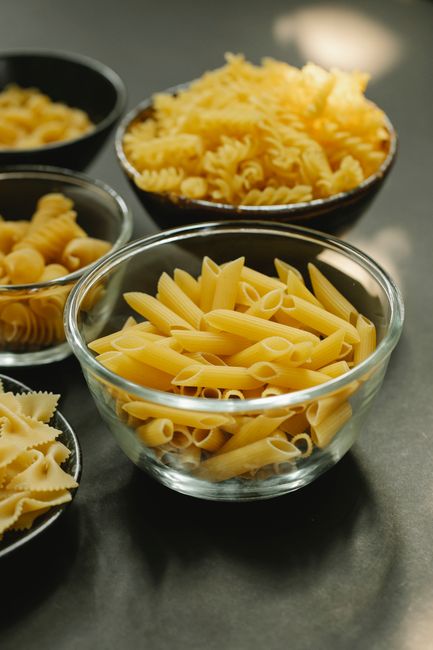
Pasta shape is not just aesthetic. The width, surface texture, and hollow spaces of a shape determine how much sauce it picks up and how it cooks. Shapes fall into a few broad families: long strands (spaghetti, linguine, fettuccine), short tubes (penne, ziti, rigatoni), curved or twisted shapes (fusilli, gemelli, orecchiette), small shapes for soup or salad (ditalini, orzo, farfalline), and stuffed pasta (ravioli, tortellini). Within a family, shapes usually cook in a similar amount of time and hold sauce in a similar way, which is why they can often stand in for each other.
Varieties
Fresh pasta and dried pasta are functionally different products even in the same cut shape. Fresh pasta, made with eggs and soft wheat flour, is tender and cooks in minutes, while dried pasta, made from durum semolina and water, holds a firmer bite and keeps for months. Some shapes, like tagliatelle and pappardelle, are almost always sold fresh, while others, like penne and fusilli, are almost always dried.
Buying tips
Bronze-die extruded pasta has a rougher, more porous surface that grabs sauce better than the smoother pasta made with Teflon dies; the surface will look matte rather than glossy. Check the box for cook time as a rough guide to shape thickness, and buy imported Italian durum wheat pasta if the box feels heavier and denser than usual, since it tends to hold its bite better.
Substitutes
Any other short tube (penne, ziti, rigatoni, mostaccioli) — 1:1 by weight
These cook in roughly the same 9-12 minute range and hold chunky or baked sauces similarly, since they share a hollow center and similar diameter.
Any other long strand (spaghetti, linguine, fettuccine, bucatini) — 1:1 by weight
Cook times are close (8-11 minutes) and thin oil- or tomato-based sauces cling to all of them in a similar way, though flat shapes like fettuccine carry cream sauces slightly better than round spaghetti.
Any other twisted or ridged shape (fusilli, gemelli, cavatappi, rotini) — 1:1 by weight
The grooves and curls trap chunky vegetable or meat sauces well, making these shapes largely interchangeable in baked pasta and pasta salad.
Small shapes for soup (ditalini, orzo, acini di pepe, small shells) — 1:1 by weight
These cook in 6-9 minutes and are chosen mainly to stay spoon-sized in broth; any of them works in minestrone or pasta e fagioli.
Gluten-free pasta (corn, rice, or chickpea blend) in the matching shape — 1:1 by weight
Cooks faster and turns mushy if overcooked, and holds together less well when tossed, so undercook by 1-2 minutes and sauce it gently.
Fresh egg pasta cut into a similar shape — Not a fixed ratio
Fresh pasta cooks in 2-4 minutes instead of 8-12 and has a softer, richer texture, so it changes the dish enough that it should be treated as a different pasta rather than a direct swap.
Storage
Dried pasta keeps in an airtight container in the pantry for 1-2 years past its printed date as long as it stays dry. Fresh pasta should be refrigerated and used within 2-3 days, or frozen in a single layer on a tray before bagging, where it keeps for about 2 months and can be boiled directly from frozen.
How to use
Match sauce weight to shape: thin oil, garlic, or light tomato sauces suit long strands; thick, chunky, or meat-based sauces suit tubes and ridged shapes that trap the sauce; small shapes go into soups and cold salads; stuffed shapes are typically served with a simple butter, sage, or light tomato sauce that doesn't overwhelm the filling.
What it pairs with
Long strands pair with olive oil, garlic, seafood, and light cream sauces. Tubes and ridged shapes pair with bolognese, sausage ragu, and baked cheese dishes. Small shapes pair with brothy soups, beans, and cold vegetable salads. Stuffed pasta pairs with brown butter, sage, or a light marinara that won't mask the filling.
Nutrition
Most dried pasta is made from durum wheat semolina and provides about 200 calories and 7-8 grams of protein per 2-ounce (56g) dry serving. Whole wheat versions add 3-4 grams of fiber per serving; the shape itself doesn't change the nutrition, only the wheat type, egg content, and portion size do.
FAQ
Does the shape of pasta actually change how a dish tastes?
The pasta itself tastes the same across shapes, but shape changes how much sauce reaches your fork per bite, which changes the overall flavor balance of the dish even though the pasta ingredient hasn't changed.
Can you substitute a short pasta for a long pasta in any recipe?
Not cleanly. Baked dishes and dishes with chunky sauce work fine with either, but dishes built around twirling strands, like a classic aglio e olio, lose their intended eating experience if swapped for a short tube.
Why do pasta shapes have different cook times even at similar sizes?
Thickness and density matter more than overall size; a thick tube like rigatoni takes longer to cook through than a thin, flat noodle of similar length because water has to penetrate more material.
Is it fine to mix two different pasta shapes in the same pot?
Only if they have very close listed cook times, since shapes with even a 2-3 minute cook time gap will leave one shape mushy or the other underdone by the time the pot is drained.
Have pasta shapes on hand? Find recipes with our Recipe Generator →