Baked Lamb's Milk Cheese with Honey and Walnuts Recipe
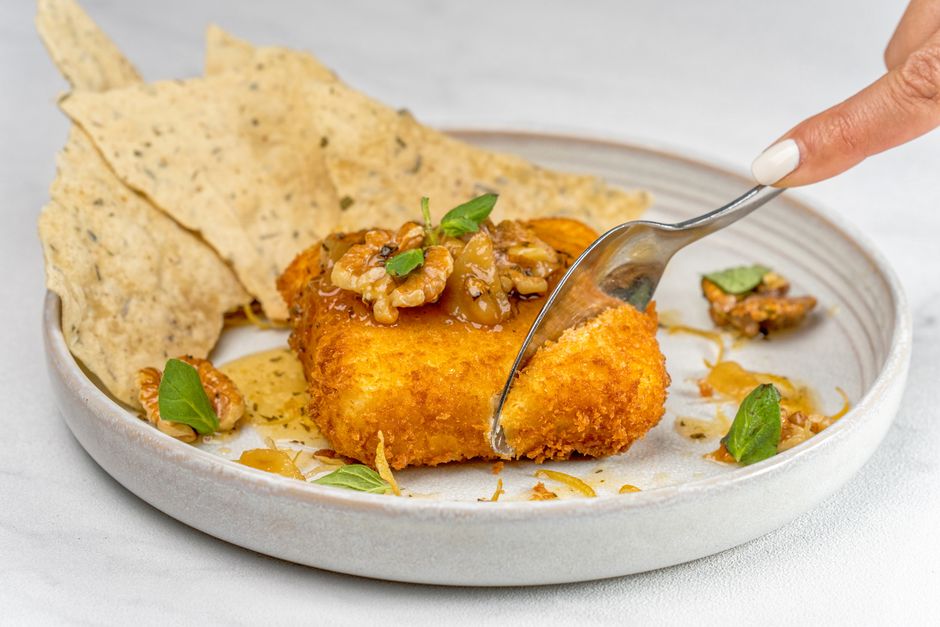
High heat softens a firm lamb's milk cheese (sheep's milk cheese like Manchego or aged Pecorino) into a spreadable, custardy center while the rind holds everything together so it can be lifted straight from the dish, and the honey and walnuts added after baking stay distinct instead of melting into the cheese.
- Prep
- 10 min
- Cook
- 15 min
- Total
- 25 min
- Servings
- 6
Ingredients
- 8 ounces lamb's milk cheese (firm sheep's milk cheese such as Manchego or aged Pecorino), rind on
- 1 tablespoon olive oil
- 2 tablespoons honey
- 1/4 cup walnuts, chopped
- 1 teaspoon fresh thyme leaves
- 1/4 teaspoon cracked black pepper
- 1/2 loaf baguette, sliced, for serving
Nutrition per serving
- Calories
- 207
- Protein
- 10g
- Carbs
- 7g
- Fat
- 16g
Based on the recipe as written, one serving. Recalculates if you swap an ingredient above. An estimate only, exact values depend on the specific ingredients used.
Need different units or a different yield? Try our Conversion Calculator →
Instructions
- 1Preheat the oven to 400°F (200°C).
- 2Let the lamb's milk cheese come to room temperature for about 15 minutes, then pat it dry and set it whole, rind side down, in a 6-inch round baking dish or small ovenproof skillet.
- 3Drizzle the cheese with olive oil and season with cracked black pepper.
- 4Bake for 12-15 minutes, until the cheese is soft to the touch and slightly puffed but still holding its shape; it should jiggle gently when the dish is nudged.
- 5Remove from the oven and immediately drizzle with honey, then scatter the walnuts and thyme over the top.
- 6Let rest 3-5 minutes so the center sets slightly before serving warm, straight from the dish, with sliced baguette for scooping.
Tips & variations
- Firm, aged sheep's milk cheeses like Manchego or aged Pecorino Romano hold their shape best when baked; very soft, fresh sheep's milk cheeses will spread thin and lose the spoonable center.
- Swap the honey for hot honey or a spoonful of fig jam for a sharper contrast against the salty cheese.
- Rosemary or a pinch of chili flakes work as a swap for the thyme if that's what's on hand.
- A splash of lemon juice over the top after baking cuts the richness if the cheese tastes heavy.
Storage & reheating
Baked lamb's milk cheese is best eaten the same day it's made, since the texture turns rubbery once fully cooled. If there are leftovers, cover and refrigerate for up to 2 days, then reheat gently in a 300°F (150°C) oven for 5-8 minutes just until softened again; microwaving tends to make the rind tough.
Tips from the Tulo kitchen
- Buy the cheese as a small whole wheel rather than pre-sliced wedges; a cut wedge has more exposed surface and can ooze out the sides before the center softens.
- A cast iron skillet holds heat well and keeps the cheese warm at the table longer than a ceramic dish.
FAQ
What is lamb's milk cheese, exactly?
Despite the name, it's made from sheep's milk, not milk from lambs; common examples include Manchego, Pecorino, Roquefort, and many fetas. "Lamb's milk cheese" is a loose, informal way some shoppers refer to sheep's milk cheese.
How is lamb's milk cheese different from goat cheese?
Sheep's milk has roughly double the fat and protein of goat's milk, which gives sheep's milk cheeses a richer, rounder flavor and a firmer, less tangy texture than most goat cheeses.
Can I bake a soft, fresh sheep's milk cheese instead of an aged one?
A soft fresh cheese will melt much thinner and may run out of the rind, so reduce the bake time to 6-8 minutes and check often rather than following the timing for a firm aged wheel.
Where can I find lamb's milk cheese at a regular grocery store?
Look in the specialty cheese case for Manchego, Pecorino Romano, Roquefort, or feta labeled as sheep's milk; most large grocery stores carry at least one of these year-round.