Homemade Ramen Noodles Recipe
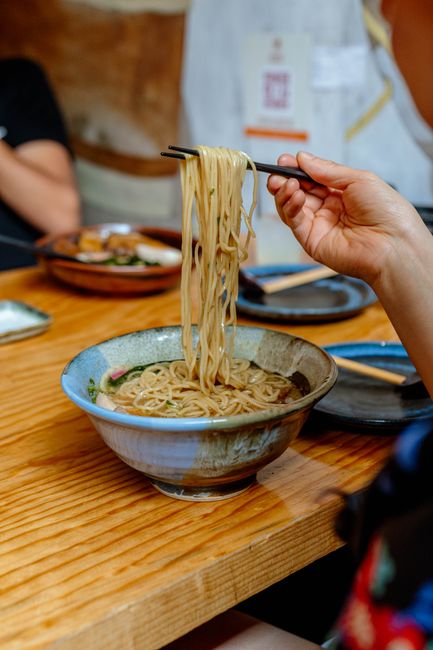
Ramen noodles need a firm, springy bite that regular pasta doesn't have, and that comes down to two things: flour protein and alkalinity. Bread flour, with 12-14% protein, builds far more gluten than all-purpose flour, giving the dough the structure to hold up in hot broth without turning mushy. Kansui (an alkaline mineral water, easily replicated by baking regular baking soda into sodium carbonate) raises the dough's pH, which tightens that gluten network further, turns the noodles pale yellow, and gives them the faint mineral, springy chew that's unmistakably ramen rather than udon or spaghetti.
- Prep
- 90 min
- Cook
- 3 min
- Total
- 93 min
- Servings
- 4
Ingredients
- 2 1/2 cups high-protein bread flour (12-14% protein)
- 1 teaspoon baked baking soda (or kansui powder)
- 1/2 cup plus 2 tablespoons water, room temperature
- 1/2 teaspoon fine sea salt
- 2 tablespoons potato starch or cornstarch, for dusting
Nutrition per serving
- Calories
- 462
- Protein
- 9g
- Carbs
- 101g
- Fat
- 1g
Based on the recipe as written, one serving. Recalculates if you swap an ingredient above. An estimate only, exact values depend on the specific ingredients used.
Need different units or a different yield? Try our Conversion Calculator →
Instructions
- 1Preheat the oven to 250°F (120°C). Spread the baking soda in a thin layer on a baking sheet and bake for 1 hour, stirring once halfway, to convert it into sodium carbonate (kansui). Let cool completely; it will look slightly clumpier and chalkier than regular baking soda.
- 2Dissolve the baked baking soda and salt in the room-temperature water, stirring until fully dissolved.
- 3In a large bowl or stand mixer fitted with a dough hook, combine the bread flour and the alkaline water. Mix on low speed for 8-10 minutes, or knead by hand for 12-15 minutes, until the dough is very firm and only just holds together; it will look shaggy and crumbly at first, not smooth like bread dough.
- 4Gather the dough into a rough ball, wrap tightly in plastic, and let it rest at room temperature for 30 minutes, then knead briefly by hand for 1-2 minutes until it smooths out slightly.
- 5Wrap again and rest for another 30 minutes. This second rest fully relaxes the gluten so the dough rolls out without springing back.
- 6Divide the dough into 4 pieces. Working with one piece at a time (keep the rest covered), flatten it and pass it through a pasta roller, starting at the widest setting and working down to about 1/16 inch (1.5mm) thick, folding and re-rolling the dough through the widest setting 3-4 times at the start to strengthen it.
- 7Dust the rolled sheet generously with potato starch on both sides, then run it through the fine ramen-cutting attachment (or slice by hand into 1/8-inch/3mm strands). Toss the cut noodles with a little more starch and coil into loose nests.
- 8Bring a large pot of unsalted water to a rolling boil. Cook the fresh noodles for 60-90 seconds, until they float and turn slightly translucent, then drain immediately and add straight to hot broth (do not rinse, since rinsing washes off the surface starch that helps the noodles cling to broth).
Tips & variations
- If bread flour isn't available, mix all-purpose flour with 1-2 tablespoons of vital wheat gluten per cup to raise the effective protein content closer to bread flour's range.
- Straight kansui liquid (potassium carbonate and sodium carbonate blend) can be bought online and used in place of the baked baking soda; use about 1 tablespoon per 300g of flour.
- For thicker, chewier noodles like those used in tonkotsu ramen, roll the dough to about 1/8 inch (3mm) and cut with a wider blade.
- Fresh, uncooked noodles freeze well: dust heavily with starch, coil into nests, and freeze on a tray before bagging so they don't stick together.
Storage & reheating
Store un-cooked fresh noodles, well dusted with starch, in an airtight container in the refrigerator for up to 2 days, or freeze for up to 2 months and cook straight from frozen, adding about 30 seconds to the boil time. Cooked noodles don't hold well and should be boiled fresh right before serving.
Tips from the Tulo kitchen
- Weighing the flour and water on a kitchen scale matters more here than in most doughs, since ramen dough is deliberately dry and low-hydration, and small measuring differences change the kneading time significantly.
- A pasta machine makes rolling this stiff dough far easier than a rolling pin; the repeated folding through the widest setting does most of the gluten-building work.
FAQ
What is the best flour for ramen noodles?
High-protein bread flour (around 12-14% protein) is best because it builds enough gluten to give the noodles their characteristic springy, chewy bite. All-purpose flour, at around 10-11% protein, makes noodles that are noticeably softer and less resilient in hot broth.
Can I use all-purpose flour instead of bread flour?
Yes, but the noodles will be softer and less chewy. Boosting all-purpose flour with 1-2 tablespoons of vital wheat gluten per cup gets it closer to bread flour's protein level and texture.
Do I really need kansui or baked baking soda?
Yes, it is what makes ramen noodles taste and feel different from regular pasta. Without an alkaline ingredient, the dough behaves like standard wheat noodles, with a softer bite and no yellow tint, since the alkalinity is what firms the gluten and shifts the color.
Why is my ramen dough so dry and crumbly?
That's normal for ramen dough, which is intentionally low-hydration (roughly 30-35% water to flour by weight). It will look shaggy after mixing but come together into a firm, smooth dough after kneading and two rest periods.
Can I make ramen noodles without a pasta machine?
Yes, but it takes more effort. Roll the dough as thin and evenly as possible with a rolling pin, dust well with starch, then fold it loosely and slice into thin strands with a sharp knife.