Lobster Tail Pastry Recipe

Laminating the dough with a thin coat of shortening before rolling it into a log creates hundreds of paper-thin layers that separate and shatter in the oven's high heat, while chilling the pastry cream fully before piping keeps the filling from turning the crisp shell soggy.
- Prep
- 3 hr
- Cook
- 20 min
- Total
- 3 hr 20 min
- Servings
- 12
Ingredients
- 2 cups bread flour
- 3/4 cup water
- 1 tablespoon honey
- 1/2 teaspoon salt
- 1 cup vegetable shortening, softened
- 2 cups whole milk
- 1/2 cup granulated sugar
- 1/4 cup cornstarch
- 4 large egg yolks
- 1 teaspoon vanilla extract
- 1 teaspoon orange zest
- 2 tablespoons powdered sugar, for dusting
Nutrition per serving
- Calories
- 324
- Protein
- 5g
- Carbs
- 31g
- Fat
- 20g
Based on the recipe as written, one serving. Recalculates if you swap an ingredient above. An estimate only, exact values depend on the specific ingredients used.
Need different units or a different yield? Try our Conversion Calculator →
Instructions
- 1In a stand mixer fitted with the dough hook, combine the bread flour, water, honey, and salt. Knead on medium speed for 10-12 minutes, until the dough is very smooth, stiff, and elastic. Wrap tightly in plastic wrap and rest at room temperature for 1 hour.
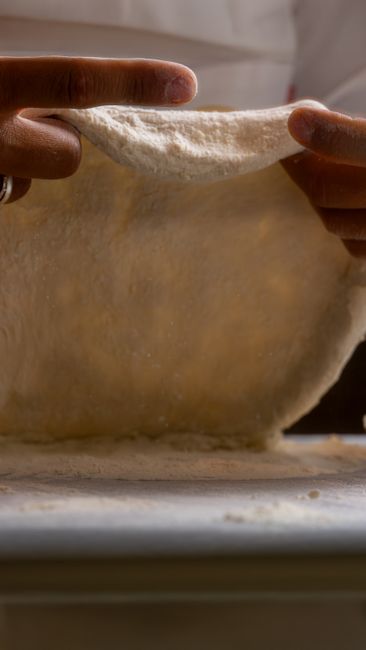
- 2Divide the dough into 2 pieces. Using a pasta roller, feed each piece through progressively narrower settings down to the thinnest one, dusting lightly with cornstarch as needed, until you have long, paper-thin sheets you can nearly see through.
- 3Lay one sheet on a lightly floured counter and spread a very thin, even layer of the softened shortening over the entire surface with an offset spatula.
- 4Starting from a short end, roll the sheet into a very tight log, stretching gently as you roll so the layers stay thin. Spread shortening on the second sheet, then wrap it around the first log to extend it into one long, tightly wound cylinder.
- 5Wrap the log tightly in plastic wrap and freeze for at least 2 hours, until firm enough to slice without squashing the layers.
- 6Using a sharp knife, slice the frozen log into rounds about 1/2 inch thick.
- 7Working one round at a time, hold it in your palm and press your thumb into the center, rotating and stretching the layers outward and up the sides to form a hollow cone about 3 inches deep with thin walls. Set each shaped shell on a parchment-lined baking sheet, open side up.
- 8Preheat the oven to 425°F (220°C).
- 9Make the filling: in a saucepan, whisk the milk, sugar, and cornstarch together and cook over medium heat, whisking constantly, until thickened, about 5 minutes. Remove from the heat and whisk in the egg yolks one at a time, then return to low heat and cook 1-2 minutes more, until glossy and thick. Stir in the vanilla and orange zest, press plastic wrap directly onto the surface, and chill until fully cold, about 2 hours.
- 10Bake the empty shells for 18-22 minutes, until deep golden brown and the layers have fanned open and crisped.
- 11Let the shells cool completely on the pan, then transfer the cold filling to a piping bag and pipe it generously into each shell from the open end.
- 12Dust with powdered sugar just before serving.
Tips & variations
- For a more traditional Neapolitan filling, swap the vanilla pastry cream for sweetened ricotta mixed with a little semolina and mini chocolate chips.
- Freeze the rolled log longer, up to overnight, if it feels too soft to slice cleanly; soft layers smear instead of shatter.
- Only fill shells you plan to serve within a couple of hours; the crisp layers begin softening as soon as they meet the cold cream.
- If a round tears while shaping, patch it by pressing a small scrap of dough over the gap; it will still crisp up in the oven.
Storage & reheating
Store unfilled shells in an airtight container at room temperature for up to 2 days; a quick 5-minute pass in a 350°F (175°C) oven will re-crisp them if they've softened. Keep the pastry cream separately in the refrigerator for up to 3 days. Once filled, lobster tails are best eaten within a few hours; refrigerated filled pastries will keep about a day but the shells lose their crackle.
Tips from the Tulo kitchen
- A pasta roller machine gets the dough far thinner and more evenly than a rolling pin can, which is the difference between shells that shatter and ones that stay tough.
- Chilling your hands with cold water before shaping each cone keeps the shortening layers from softening and sticking as you work.
FAQ
Is there actual lobster in lobster tail pastry?
No. The pastry is named for its shape, a curled, ridged cone that resembles a lobster's tail, not for any seafood ingredient.
How is a lobster tail different from sfogliatelle?
Lobster tails are the larger, Italian-American cousin of sfogliatelle riccia. They're typically stuffed with vanilla or chocolate pastry cream or whipped cream rather than the traditional semolina-ricotta filling, and are often dipped or drizzled with a sugar glaze.
Why didn't my shells fan open in the oven?
This usually means the shortening layer was too thin or skipped, or the dough wasn't rolled thin enough; both prevent the layers from separating under the oven's heat.
Can the dough be made ahead of time?
Yes. The kneaded dough can be wrapped and refrigerated for up to 2 days before rolling, and the shaped, unbaked log can be frozen for up to a month; thaw it just until sliceable before shaping.