
Maracuya
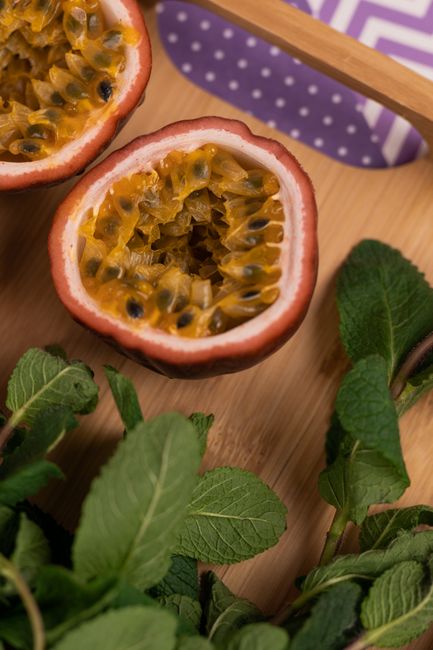
Maracuya (Passiflora edulis) is the Spanish name for passion fruit, a tropical fruit with a hard, waxy rind and a jelly-like interior packed with crunchy black seeds. The pulp is intensely tart, floral, and sweet-tart at once, and it's a staple flavor across Colombia, Peru, Ecuador, and Brazil, where it shows up in juices, sauces, and desserts far more often than eaten out of hand.
Varieties
Purple maracuya (Passiflora edulis f. edulis) is smaller and more aromatic, favored for eating fresh and for premium juice in Colombia and Brazil. Yellow maracuya (f. flavicarpa) is larger, more acidic, and grown mainly for commercial juice and concentrate.
Buying tips
Pick fruit that feels heavy for its size and has wrinkled, slightly dimpled skin, that wrinkling signals ripeness. Smooth, hard, glossy skin means the fruit is underripe and needs a few more days at room temperature.
Substitutes
Frozen passion fruit pulp or puree — 1:1
Sold in Latin markets, often already sweetened; check the label and adjust added sugar if the puree is presweetened.
Passion fruit concentrate, diluted — 1 part concentrate to 3-4 parts water
Common in juice aisles; dilute to taste since brands vary widely in sweetness and acidity.
Mango puree plus lime juice — 3 parts mango puree to 1 part lime juice, in place of the maracuya amount called for
Approximates the tart-sweet balance and color but loses the floral aroma and crunchy seeds.
Guava pulp — 1:1
Milder and less acidic; works in drinks and glazes but won't match maracuya's sharp tang.
Storage
Whole maracuya can sit at room temperature until the skin wrinkles, which is when it's ripest and sweetest. Once wrinkled, refrigerate and use within a week. Scooped pulp keeps refrigerated for about 3 days or can be frozen in an airtight container for up to 6 months.
How to use
Blend the pulp with water and sugar for juice, strain it into curds, mousses, and cheesecake toppings, or reduce it into a glaze for grilled fish and pork. It's also a classic base for cocktails and for topping yogurt or panna cotta.
What it pairs with
Pairs well with coconut, mango, dark chocolate, chili, and citrus, and cuts nicely through rich meats like pork belly or duck. Common in cocktails with rum, tequila, or cachaça.
Nutrition
Maracuya is high in vitamin C and provides a decent amount of vitamin A and fiber, much of the fiber coming from the edible seeds.
FAQ
Is maracuya the same thing as passion fruit?
Yes. Maracuya is simply the Spanish (and Portuguese, as maracujá) name for passion fruit; it's the same fruit sold under different labels depending on the region.
Can you eat the seeds inside maracuya?
Yes, the black seeds are edible and crunchy. Most people blend or strain the pulp for juice but leave the seeds in for baked goods or yogurt toppings for texture.
How do you open a maracuya?
Cut it in half crosswise with a knife and scoop out the pulp and seeds with a spoon, similar to eating a passion fruit or kiwi.
Why is my maracuya juice so tart even after adding sugar?
Maracuya's acidity is naturally high, so juice recipes typically call for a simple syrup rather than granulated sugar, since syrup dissolves evenly and lets you adjust sweetness without a grainy result.
Have maracuya on hand? Find recipes with our Recipe Generator →