Perfectly Cooked Baked Chicken Breast Recipe
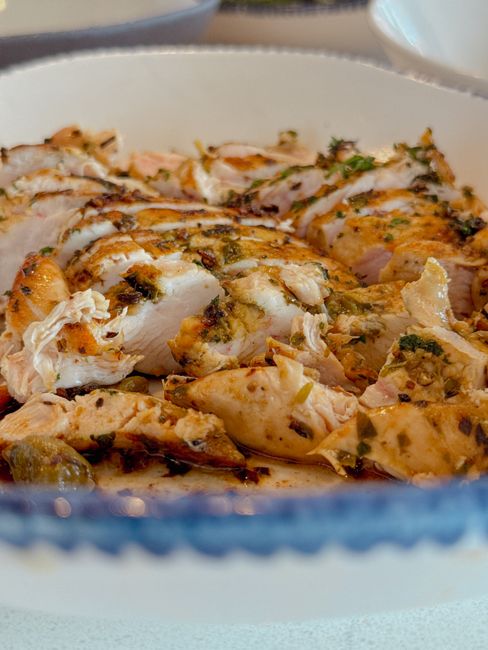
Chicken is safe to eat the moment its internal temperature hits 165°F (74°C) anywhere in the thickest part, regardless of color or juice clarity, so a thermometer removes all the guesswork that leads to either undercooked or dried-out chicken. This method uses a hot oven and a quick sear-like start to get the outside browned before the inside overshoots that mark.
- Prep
- 5 min
- Cook
- 25 min
- Total
- 30 min
- Servings
- 4
Ingredients
- 4 breasts (6-8 oz each) boneless, skinless chicken breasts
- 2 tablespoons olive oil
- 1 teaspoon kosher salt
- 1/2 teaspoon black pepper
- 1 teaspoon garlic powder
- 1 teaspoon paprika
Nutrition per serving
- Calories
- 295
- Protein
- 44g
- Carbs
- 1g
- Fat
- 12g
Based on the recipe as written, one serving. Recalculates if you swap an ingredient above. An estimate only, exact values depend on the specific ingredients used.
Need different units or a different yield? Try our Conversion Calculator →
Instructions
- 1Preheat the oven to 425°F (220°C) and line a baking sheet with foil or parchment.
- 2Pat the chicken breasts completely dry with paper towels. If they vary a lot in thickness, pound the thicker end gently so all four breasts are roughly the same thickness.
- 3Rub the breasts all over with olive oil, then season both sides with salt, pepper, garlic powder, and paprika.
- 4Arrange the breasts on the baking sheet with space between them and bake for 18-22 minutes, depending on thickness.
- 5Start checking the internal temperature at the 18-minute mark by inserting an instant-read thermometer into the thickest part of the largest breast, avoiding bone or the pan. Pull the chicken from the oven once it reads 160-162°F (71-72°C).USDA safe minimum for poultry: 165°F (74°C)
- 6Let the chicken rest on the pan for 5 minutes before slicing; the temperature will climb the last few degrees to 165°F (74°C) as it rests.
Tips & variations
- A thermometer is the only reliable way to judge doneness; color is a poor indicator because chicken can look pink even at 165°F if myoglobin reacts with residual nitrites or gas in the oven, and it can look fully white well before it's actually safe.
- For bone-in, skin-on chicken thighs, aim for the same 165°F (74°C) at the thickest part near the bone, though thighs taste and feel better pulled closer to 175-180°F (79-82°C) since the extra collagen only breaks down fully at higher heat.
- Brining the breasts in a simple salt water solution for 30 minutes before baking helps them hold onto moisture even if they're slightly overcooked.
- For a whole roast chicken, check the temperature in the thickest part of the thigh, not the breast, since the thigh is the last part to reach a safe temperature.
Storage & reheating
Refrigerate cooked chicken in an airtight container for up to 4 days. Reheat gently in a 300°F (150°C) oven covered with foil until warmed through, or slice and add cold to salads, since high-heat microwave reheating tends to dry it out further. Cooked chicken also freezes well for up to 3 months; thaw overnight in the refrigerator before reheating.
Tips from the Tulo kitchen
- Calibrate an instant-read thermometer in a glass of ice water before relying on it; it should read 32°F (0°C), and if it's off by more than a couple of degrees, adjust your target temperature accordingly.
- Insert the thermometer sideways through the side of the breast rather than straight down through the top, which makes it easier to hit the true center without poking through to the pan.
FAQ
What temperature is chicken done at?
Chicken is safe to eat once its internal temperature reaches 165°F (74°C) anywhere in the thickest part, according to USDA guidelines. This applies to all cuts, including breasts, thighs, wings, and ground chicken.
Is chicken still safe if it's pulled below 165°F and rests?
Yes, as long as it reaches 165°F at some point. Carryover cooking typically raises the internal temperature 3-5°F after chicken comes out of the oven, so pulling breasts at 160-162°F and letting them rest 5 minutes usually gets them to 165°F without drying out the outside.
Why is my chicken still pink at 165°F?
Pink coloring near the bone or in the meat can happen even at a safe temperature, caused by residual myoglobin or minor gas reactions during cooking. Temperature, not color, is the only reliable doneness indicator, so trust the thermometer reading over the visual.
Do chicken thighs need to reach a higher temperature than breasts?
Both are safe at 165°F (74°C), but thighs have more connective tissue and taste noticeably more tender when cooked to 175-180°F (79-82°C), since that extra collagen has time to break down into gelatin.
What temperature should ground chicken reach?
Ground chicken should reach 165°F (74°C) throughout, checked in the thickest part of a patty or meatball, since grinding distributes any surface bacteria through the whole batch.