Sourdough Focaccia Recipe
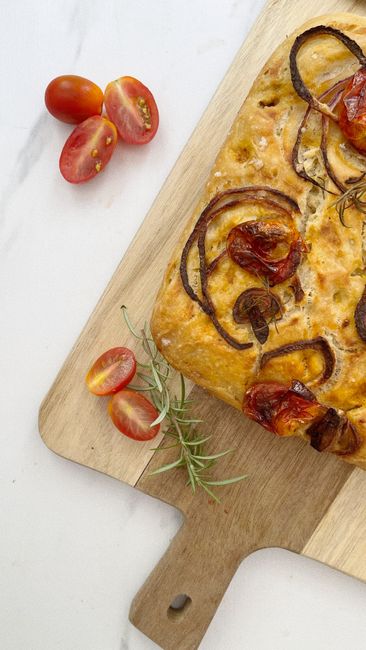
A long, cool fermentation with active sourdough starter builds the deep, tangy flavor and open, irregular crumb that yeasted focaccia can't match, while a well-oiled pan and firm dimpling give it the signature crisp, almost fried bottom crust.
- Prep
- 30 min
- Cook
- 25 min
- Total
- 655 min
- Servings
- 8
Ingredients
- 1 cup active sourdough starter, fed and bubbly
- 4 cups bread flour
- 1 cup water, room temperature
- 1/3 cup olive oil, divided, plus more for the pan
- 2 tsp fine sea salt
- 1 tsp honey
- 2 tbsp fresh rosemary, chopped
- 1 tsp flaky sea salt, for topping
Nutrition per serving
- Calories
- 967
- Protein
- 30g
- Carbs
- 179g
- Fat
- 12g
Based on the recipe as written, one serving. Recalculates if you swap an ingredient above. An estimate only, exact values depend on the specific ingredients used.
Need different units or a different yield? Try our Conversion Calculator →
Instructions
- 1The night before or morning of baking, feed the sourdough starter and let it sit at room temperature until active and bubbly, about 4-6 hours, it should float when dropped in water.
- 2In a large bowl, whisk the water, starter, and honey together, then add the flour and mix with a spatula or your hand until a shaggy, no-dry-spots dough forms. Cover and let rest for 30 minutes (autolyse).
- 3Sprinkle the salt over the dough and 1 tablespoon of the olive oil, then pinch and fold the salt into the dough until fully incorporated.
- 4Over the next 2 hours, perform 4 sets of stretch and folds, reaching under the dough, pulling it up, and folding it over itself from all four sides, spaced about 30 minutes apart. Cover between folds.
- 5Cover the bowl and let the dough bulk ferment at room temperature (70-75°F) for 6-8 hours, or refrigerate overnight for 8-12 hours, until roughly doubled and full of visible bubbles.
- 6Pour 2 tablespoons of olive oil into a 9x13-inch pan and spread it to coat the bottom and sides. Turn the dough out into the pan and gently stretch it toward the corners, it will resist and spring back some, that's normal.
- 7Cover loosely and let the dough proof in the pan for 1-2 hours at room temperature, until it looks puffy and nearly fills the corners.
- 8Preheat the oven to 450°F (230°C) with a rack in the lower third.
- 9Drizzle the remaining olive oil over the dough, then press your fingertips straight down through the dough to the bottom of the pan, making dimples across the entire surface.
- 10Scatter the rosemary and flaky sea salt over the top.
- 11Bake for 20-25 minutes, until deeply golden brown on top and the bottom is crisp when you lift an edge with a spatula.
- 12Let the focaccia cool in the pan for 10 minutes, then transfer to a wire rack or cutting board before slicing.
Tips & variations
- If the starter isn't active enough on its own, let the bulk ferment run longer rather than adding commercial yeast, sourdough focaccia is more forgiving of extra time than of a rushed rise.
- Discard (unfed) starter can be used for a milder, less airy result, but the dough will need a longer bulk ferment, often 10-14 hours, to get enough lift.
- Top with thinly sliced cherry tomatoes, sliced red onion, or pitted olives pressed into the dimples before baking instead of rosemary.
- For extra-crisp edges, use a metal pan rather than glass, glass insulates and can leave the sides paler.
Storage & reheating
Store cooled focaccia in an airtight container or wrapped tightly at room temperature for up to 2 days. Freeze whole or in slices, wrapped tightly, for up to 2 months. Reheat directly in a 350°F (175°C) oven for 8-10 minutes to re-crisp the bottom; microwaving will make it tough.
Tips from the Tulo kitchen
- A starter that doubles in size and passes the float test within an hour of feeding will give the most reliable rise; a sluggish starter is the most common reason for a dense focaccia.
- Weighing the flour and water instead of using cup measures keeps the hydration consistent, which matters more in this recipe than in a standard yeasted dough.
FAQ
Can I use sourdough discard instead of active starter?
Yes, but discard has fewer active yeast and bacteria, so the bulk ferment will take noticeably longer, often 10-14 hours at room temperature, to get the same rise.
Why is my focaccia dense instead of open and airy?
This usually means the dough was baked before it finished bulk fermenting; the dough should look domed, jiggly, and full of visible bubbles under the surface before it goes into the pan.
Can I bake this the same day without an overnight fridge rise?
Yes, bulk ferment at room temperature for 6-8 hours instead, checking for doubled volume and surface bubbles rather than watching the clock, since room temperature affects timing significantly.
Why does my focaccia stick to the pan?
The pan needs a generous, visible layer of olive oil covering the entire bottom, not just a light greasing, the oil is what fries the crust and releases it from the pan.